
WINE & DINING
A Cheese Workshop with Dedicated Artisans: Atelier de Fromage
Contents
Hello, everyone.
[Wine, Food, and People (Wine Shokunin)] I am Miyuki Isobe.
This time, I visited a natural cheese creamery I love in Tomi City, Nagano Prefecture,Atelier de Fromage.
Their cheeses have won numerous awards, making this creamery well known to cheese lovers.
As someone who regularly engages in "#CheeseKatsu"—actively seeking out and enjoying delicious cheese with fellow cheese lovers—this was a delightful visit for me.
・Hisui: Gold Award (Blue Mold Category)
・Brie: Silver Award (White Mold Category)
• Yama no Cheese – Bronze Award (Unheated Pressed / Aged Under 4 Months)
• Mozzarella – Bronze Award (Pasta Filata / Mozzarella Category)
• Blue – Silver Award
• Hisui – Gold Award
These are truly impressive awards.
This workshop uses about 390 tons of raw milk per year and currently produces 15 varieties of cheese and yogurt.
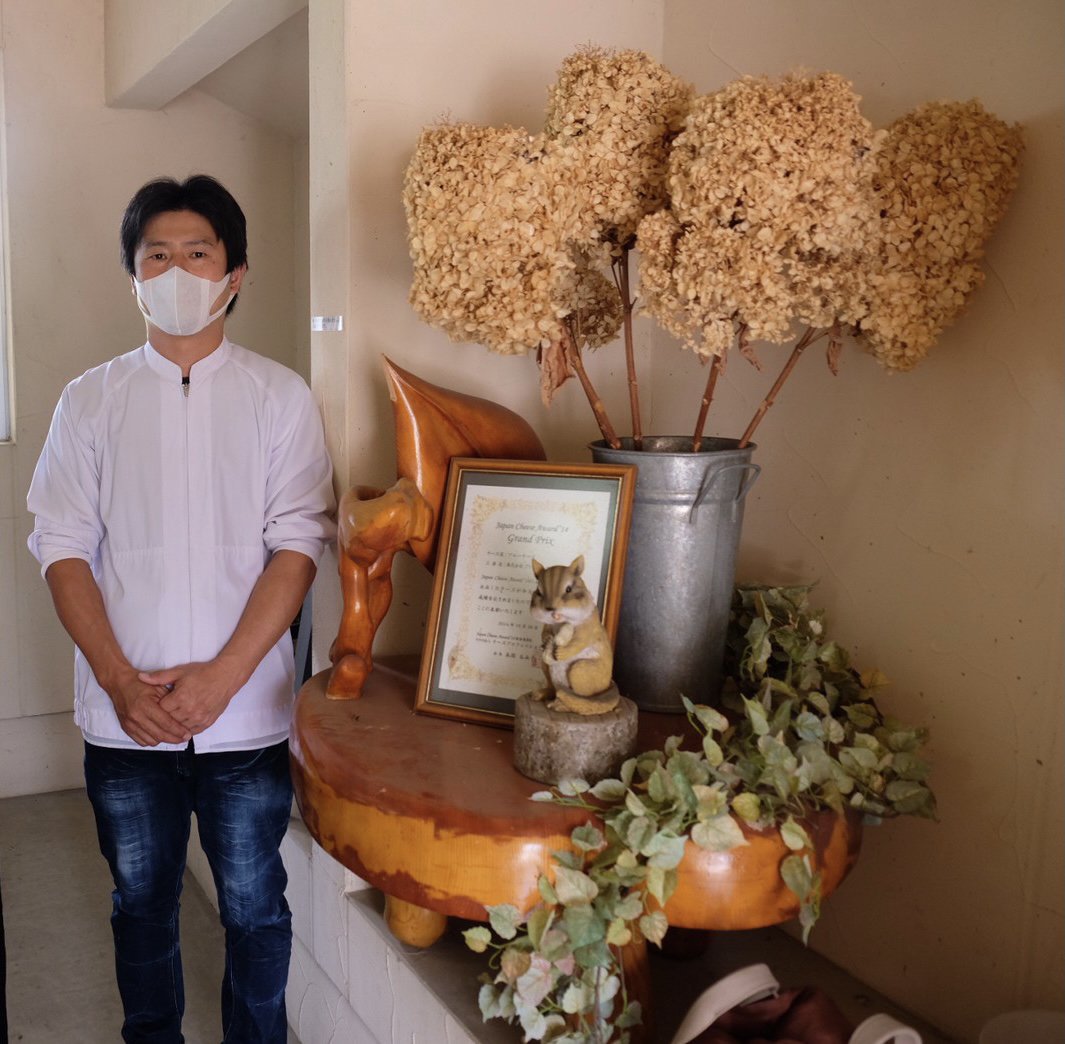
I spoke with Mr. Shiokawa, a cheesemaker of 15 years, about Atelier de Fromage's commitment to quality and how to enjoy their products, so this time I would like to try pairing them with Japanese wine based on his recommendations.
CHAPTER 01
The Burgundy of Japan?
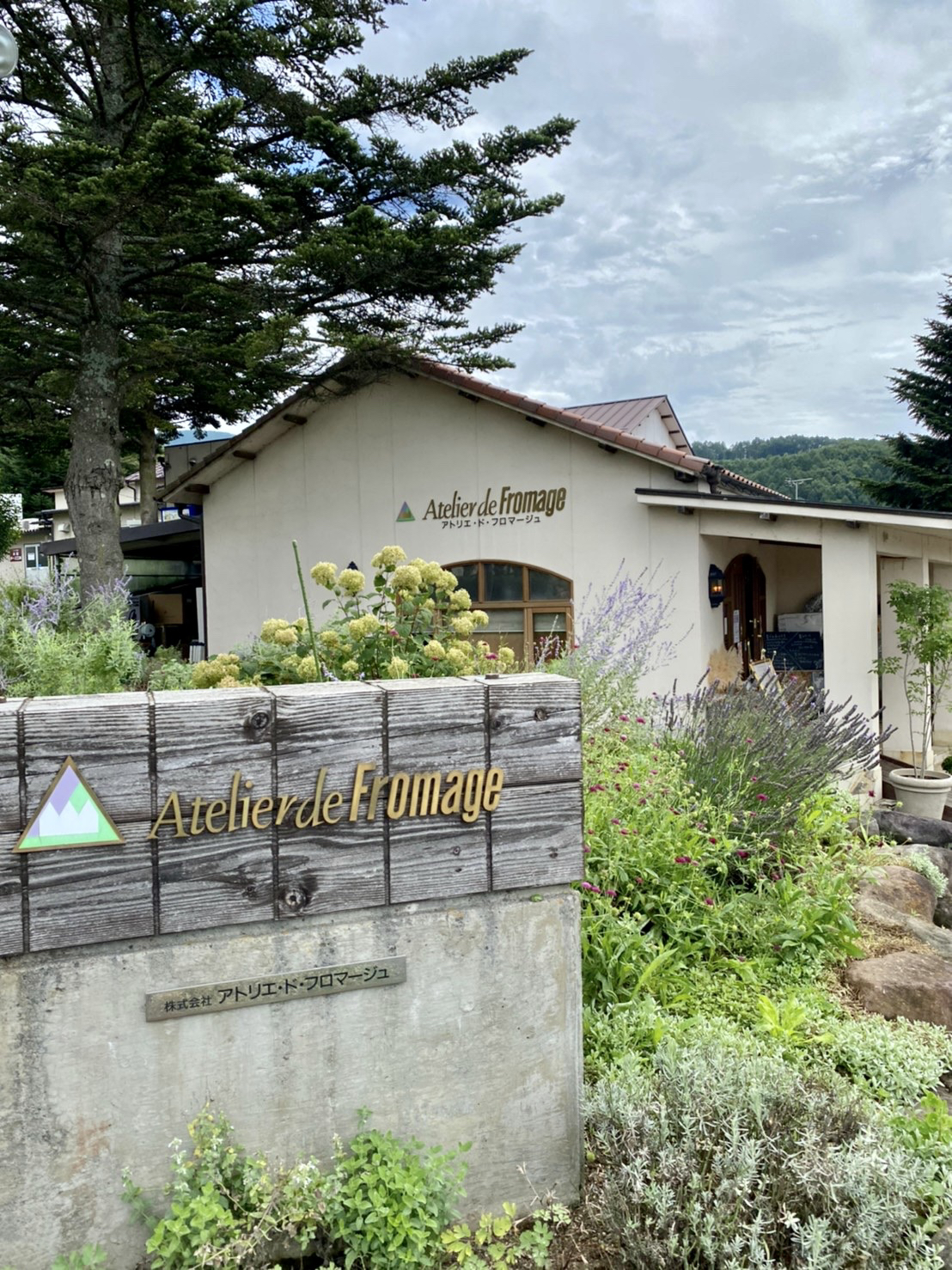
The workshop is located in Tomi City, Nagano Prefecture, about an hour's drive from Karuizawa.
If you love wine, hearing Tomi City will likely bring many wines to mind.
That's right—Tomi City is said to have a climate and terroir so similar to France, the home of cheese, that it is called the Burgundy of Japan.
Even though I've never been to France, as I drove along with my cheese-loving friends saying, "It looks just like the French countryside, so idyllic," what came into view was a lovely workshop with a red roof that perfectly matched the image of a house in rural France.
At the entrance, sheep welcomed us, and the café had a wonderful atmosphere. I couldn't help thinking it would be perfect for a drive date.
While captivated by the many cakes on display in the showcase, we started with a tour of the workshop first.
CHAPTER 02
How Cheese Is Made
To put it super simply, the process of making natural cheese goes like this:
Milk ↓← Add lactic acid bacteria and rennet, then heat Coagulated milk ↓→ Separate whey Curds ↓← Add salt, inoculate with mold, etc. Green cheese (unaged cheese) ↓ Aged cheese
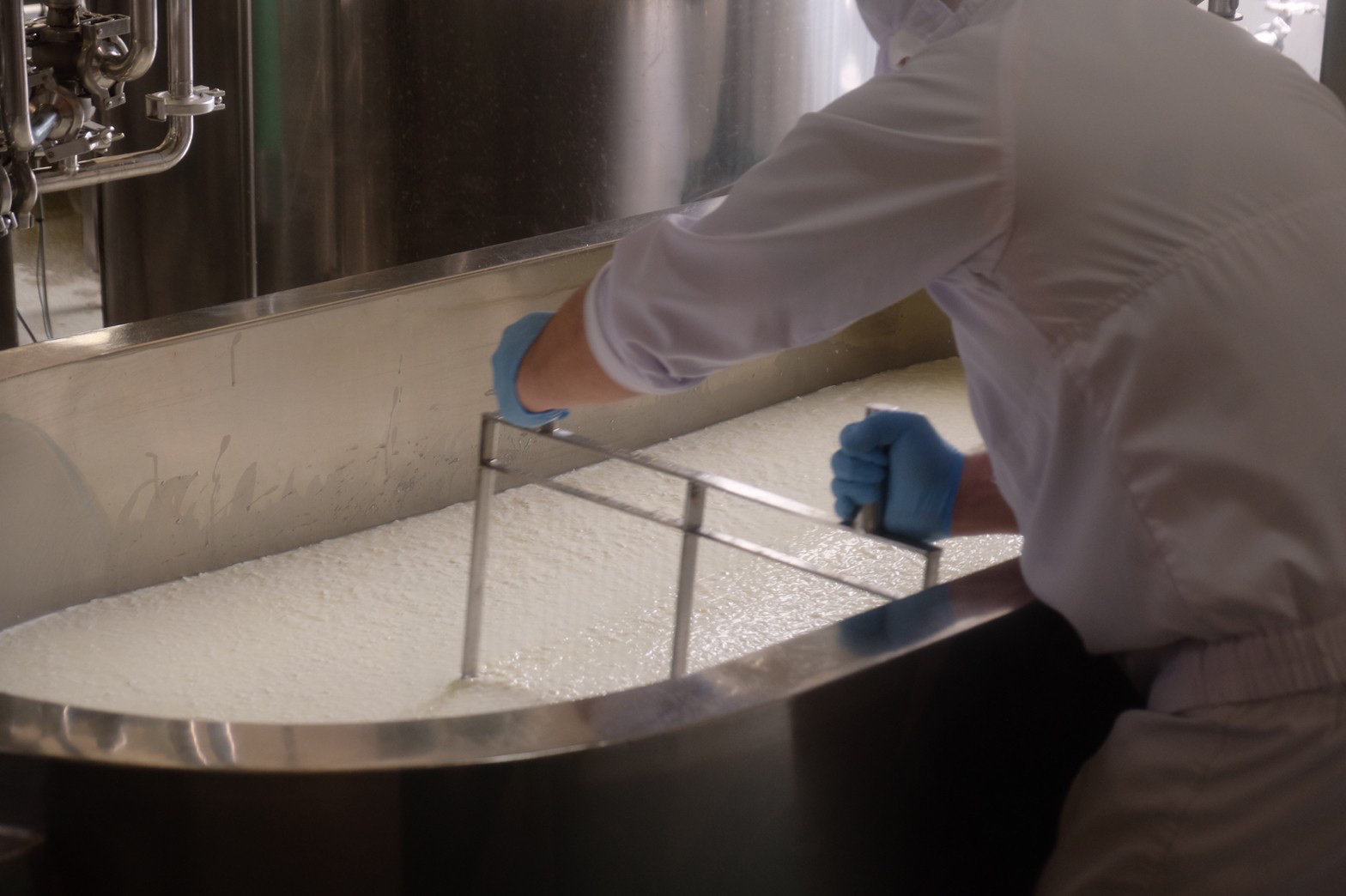
When I visited, rennet had just been added to the milk, and they were in the middle of cutting the curd as it gradually solidified.
This milk in a large, bathtub-like vat weighed about 600 kg! They say this yields around 20 wheels of semi-hard cheese, each weighing about 3 kg.
When you think about it, cheese is truly an efficient food packed tightly with that much nutrition.
And apparently, this work is quite a physical challenge.
CHAPTER 03
Atelier de Fromage's Dedication
Now, while cheese is made through a process like the one described above, much like wine, each cheese expresses its own deliciousness and individuality depending on the raw ingredients (milk, in this case) and how it is made.
I asked Mr. Shiokawa about the special commitments unique to Atelier de Fromage.
★ Raw Milk Ratios
They mainly use milk from Holsteins (the familiar black-and-white dairy cows), Jerseys, and Brown Swiss raised at nearby farms, each with distinct milk components.
One of the most important components that heavily affects cheese is fat content, which changes the flavor of the cheese.
Depending on the season, the cheesemaker personally checks the components at that time and blends them in optimal proportions.
★ Heating the Curd
The temperature here is another crucial point, as it affects the flavor and firmness of the cheese.
For instance, Italy's famous hard cheese, Parmigiano-Reggiano, is heated up to 55°C.
Semi-hard cheeses are generally kept below 40°C.
However, Mr. Shiokawa's artisan spirit shines here as well.
Although he uses a thermometer, in the end, it comes down to his own senses. He says, "If you rely entirely on it, it won't mean anything if the thermometer is broken."
Using an artisan's intuition, adjustments to fat content and other elements are made through temperature control to achieve just the right flavor, sweetness, and final firmness.
★ Aging Environment
Even though this region is known as the "Bourgogne of Japan," high humidity is still a climate characteristic unique to Japan.
Rather than applying French standards across the board, they adjust the temperature, humidity, and ventilation inside the aging room to suit Tomi City's climate.
The more I heard, the more I felt that natural cheese—much like wine—reflects the local climate, terroir, and craftsmanship.
Now, what kind of wine should we pair with it?
CHAPTER 04
Japanese Cheese × Japanese Wine
We received some valuable information from Mr. Shiokawa.
It turns out the winery located closest to the farm providing the raw milk for the cheese is Chateau Mercian's Mariko Vineyard.
If that is the case, pairing the cheese with wines from Mariko Vineyard sounds like great fun.
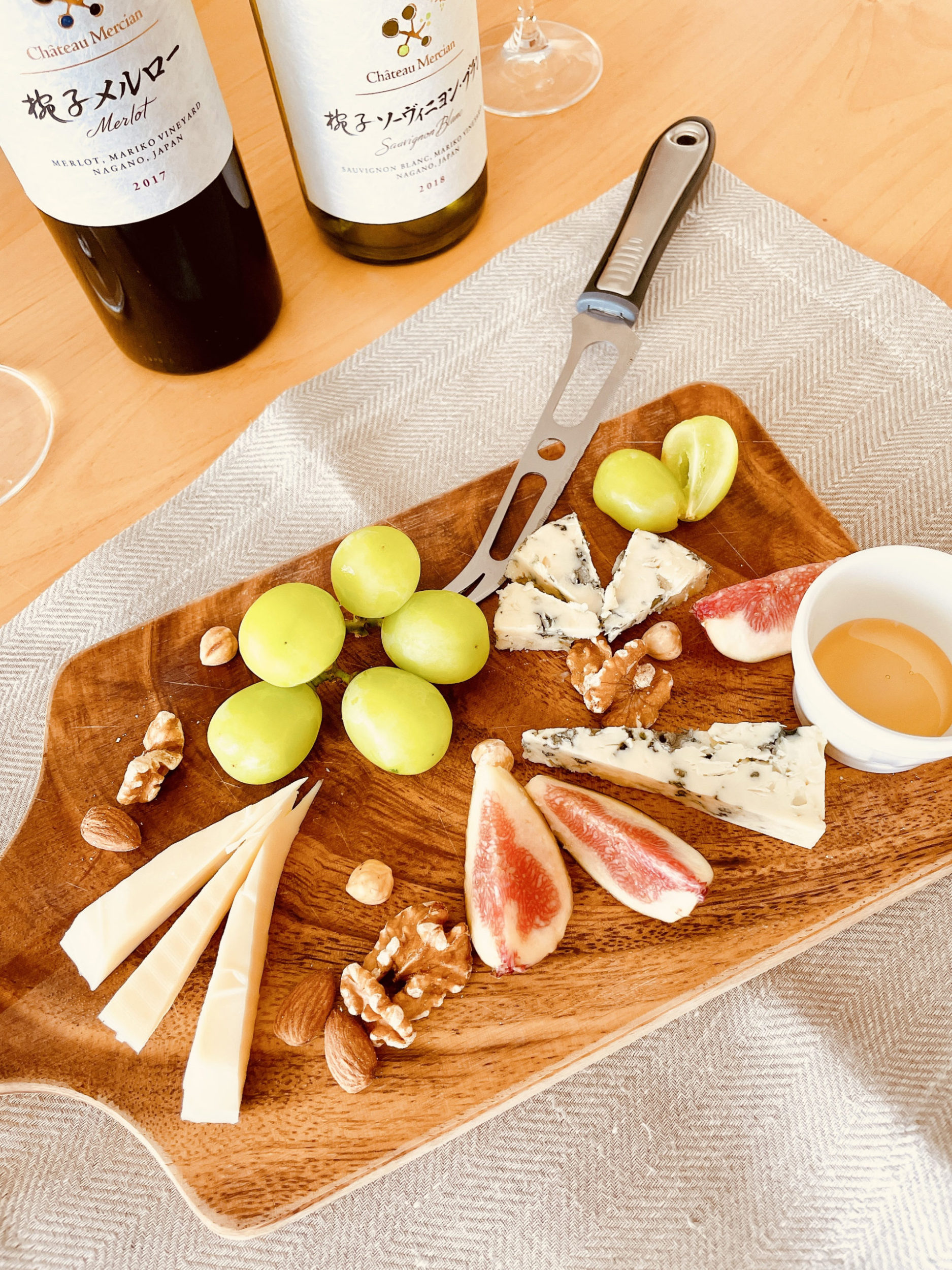
So this time, we would like to try pairing it with these two wines.
Chateau Mercian (Nagano) / Mariko Sauvignon Blanc
Made with Sauvignon Blanc from the estate-managed 'Mariko Vineyard'.
A white wine featuring aromas of citrus fruits and passion fruit, along with herbal nuances.
Chateau Mercian (Nagano) / Mariko Merlot
Made with Merlot from the estate-managed 'Mariko Vineyard'.
Aged in oak barrels for 11 months.
A well-balanced red wine featuring aromas reminiscent of dried fruit, concentrated fruitiness, and powerful tannins.
As for the cheese, since we had the opportunity, we wanted to try their award-winning blue cheeses, "Hisui" and "Blue"..
And I also purchased the "Hard Cheese" whose production process I had just been shown.
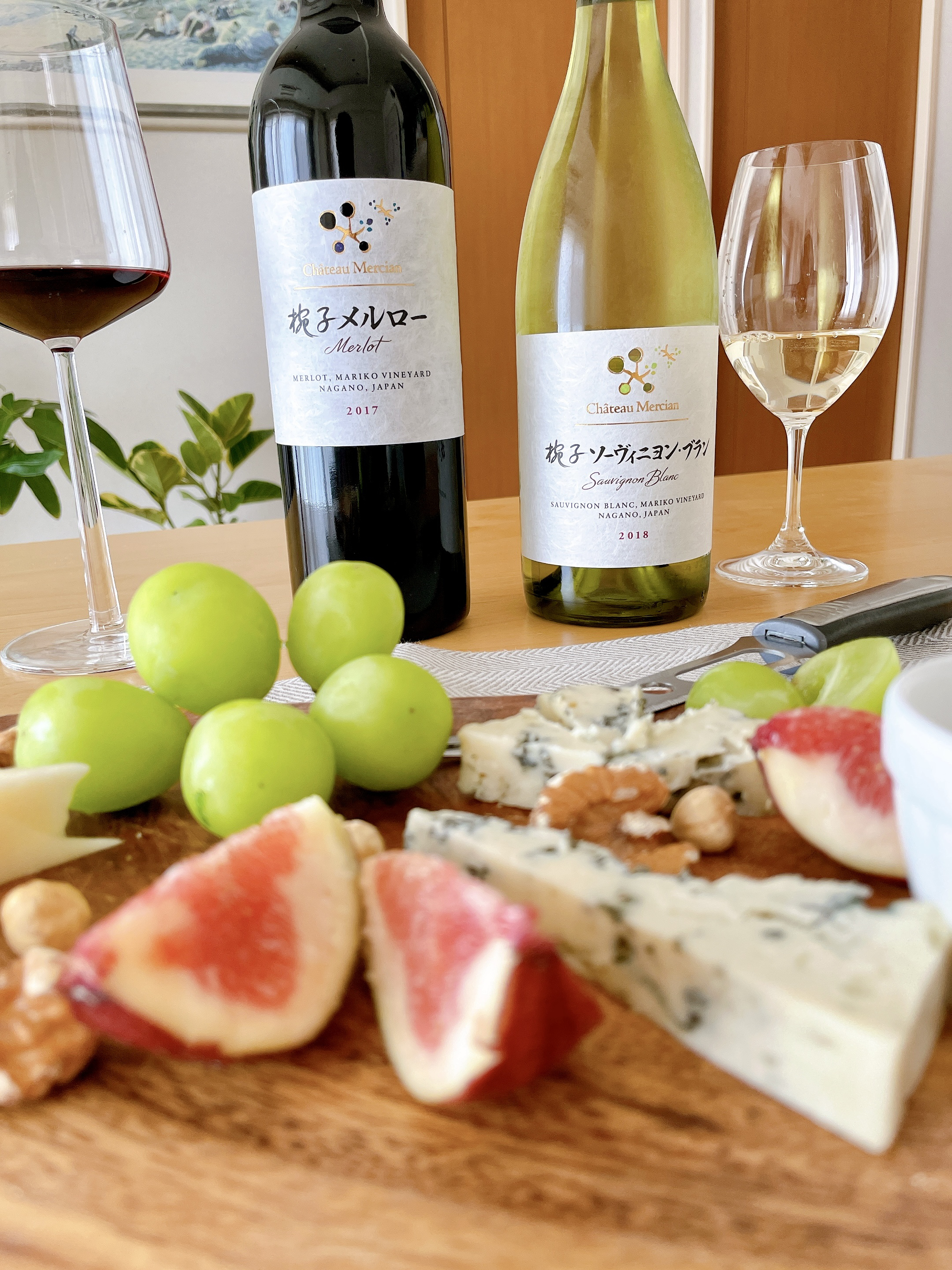
Cheese is one of those foods where, for some reason, serving it straight off the cutting board is perfectly acceptable, isn't it?
Arranging it with fruits, nuts, and the like not only makes the platter look cute, but it's also highly recommended because it provides vitamin C and dietary fiber, which cheese lacks.
Now, let's move on to the tasting.
Hisui
First, the blue mold cheese Hisui.
This is absolutely delicious! It has a smooth texture that melts in your mouth and a rich umami similar to Gorgonzola, along with a nuttiness reminiscent of Stilton, making it a truly high-quality cheese.
Because it has strong umami and a long finish, it pairs outstandingly well with a full-bodied Merlot.
This time's Sauvignon Blanc is quite dry, so while it doesn't clash, Merlot provides a much better balance for this deep umami.
Blue
As for the Blue, in terms of the impact of its saltiness, Merlot is also the better match.
Compared to Hisui, its slightly grainy blue mold presence and unique astringency are irresistible to cheese lovers.
It is also delicious served with honey drizzled over it.
Hard Cheese
Although it's called 'hard,' it has a nice, chewy elasticity.
It has an aroma like hot milk.
As for the flavor, it is very gentle, with a subtle sweetness of milk that makes it delicious.
It isn't overly hard and has a gentle flavor, so it's also recommended as a snack for children and the elderly.
This went very well with the sweet fruitiness of the Sauvignon Blanc.
Additionally, the herbal nuances characteristic of the variety refreshingly reset a palate dominated by milkiness, making it feel like you could enjoy this pairing endlessly.
'Cheese is the drinker's biscuit,' said Grimod de La Reynière, a 19th-century French gourmet. It is also said that 'cheese is wine's greatest friend.'
However, there are various tips for pairing them.
This time, I enjoyed pairing them from the perspective of matching regional origins, but there are other approaches, such as choosing wine according to the cheese's stage of aging or deriving matches based on the components of the cheese.
I want to keep trying many more combinations of Japanese natural cheese and Japanese wine.
Atelier de Fromage
https://www.a-fromage.co.jp/
About the author
Miyuki Isobe
Stories covering the same region, newest first.
- WINE & DININGThe Manns Wines You Think You Know May Be Out of Date — From Volume to Quality: Where Manns Wines Is Today6 MAY 2026Miyuki Isobe
- WINERIESThe People Who Create the “Beginning” of Wine: Visiting Suda Grape Nursery in Yamanashi Prefecture5 JAN 2026Miyuki Isobe
- WINERIESFrom a Winery in Manriki, Yamanashi: Cave an’s Winemaking That Has Mastered the Basics12 DEC 2025Miyuki Isobe
- WINERIESBringing Refreshing Relief to Sweltering Days! Delivered from Heavy Snow Country: Housui Winery23 JUN 2025Miyuki Isobe
- WINERIESBottling Yamanashi's Nature! Asking Naomichi Kondo About Komaen Vineyard's Dedication!21 APR 2025Miyuki Isobe
- WINE & DINING[Part 2] Restaurant SAI 燊 — An Evening Indulging in the Ultimate Pairing of "Oku-Yamanashi Cuisine" and Japanese Wine17 NOV 2024Miyuki Isobe
Wineries in this region
REGIONAL WINERIESRead → Know → VisitWineries in 山梨県. Find somewhere to visit.