
WINERIES
Carrying On the Passion: An Interview with Kodai Kageyama on What TAKIZAWA WINERY Holds Dear

Contents
The Sorachi region is one of Hokkaido's most watch-worthy wine areas. The crisp, acidity-driven wines produced in this snow-rich region have gained immense popularity in recent years.
TAKIZAWA WINERY is one of the iconic wineries representing the Sorachi area. We spoke with Kodai Kageyama, who assumed the role of Representative Director in 2023, about the land of Mikasa and the winery itself.
TAKIZAWA WINERY was established in 2013 by the late Nobuo Takizawa. The oldest vines were planted in 2006.
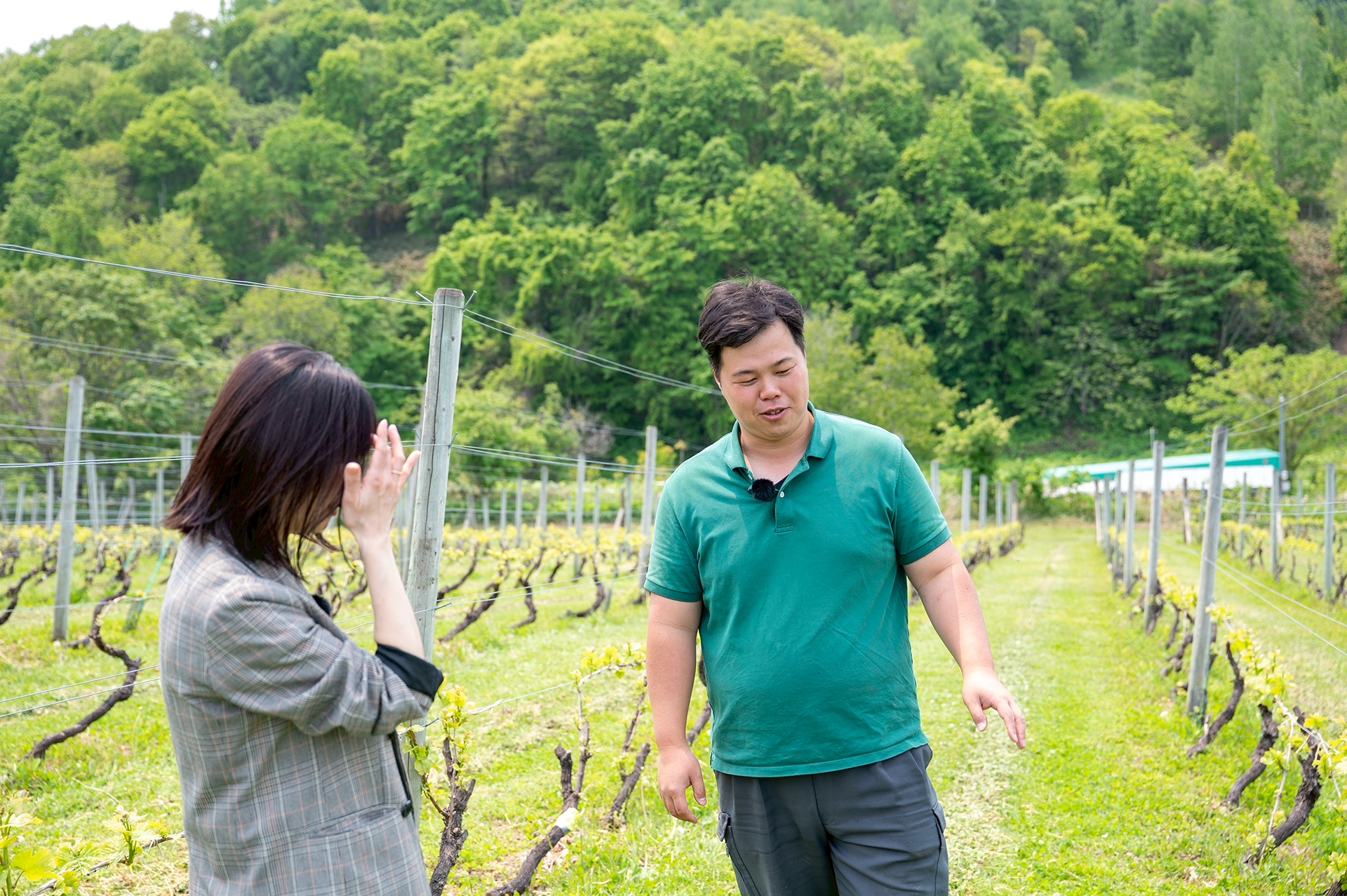
Kageyama first participated in winemaking as a volunteer several years ago. Captivated by that experience of grape growing and winemaking, he conveyed his enthusiasm to work there to then-president Takizawa and joined the winery.
Today, he and his team work tirelessly to preserve both the founder's vision and the business operations.
CHAPTER 01
TAKIZAWA WINERY's Three Vineyards
If you have tasted TAKIZAWA WINERY's wines, you may already know that their wines are named after the individual vineyards.
They manage three estate vineyards totaling 3 hectares: Kaze no Hatake (Wind Vineyard), Hi no Hatake (Sun Vineyard), and Kodachi no Hatake (Grove Vineyard).
Their elevations are 60 meters for Kaze no Hatake, 80 meters for Hi no Hatake, and 120 meters for Kodachi no Hatake. Due to the high latitude, high elevation is not particularly required.
The grapes are cultivated using the "Single Horizontal Guyot" training system.
While Hokkaido Wine originally pioneered on a large scale, planting vines at an angle and spur-pruning became the Hokkaido standard. The Takizawa style adapts this basic technique by long-pruning the canes—choosing double, or single depending on the vine.
With snow accumulation reaching around two meters, the vines are planted at an angle so they sit safely under a blanket of snow, preventing branches from breaking under the weight.
Furthermore, winter requires removing all the trellis wires. Every effort is made to protect the vines and equipment from snow and extreme cold, avoiding unnecessary risks to carefully cultivate the crop.
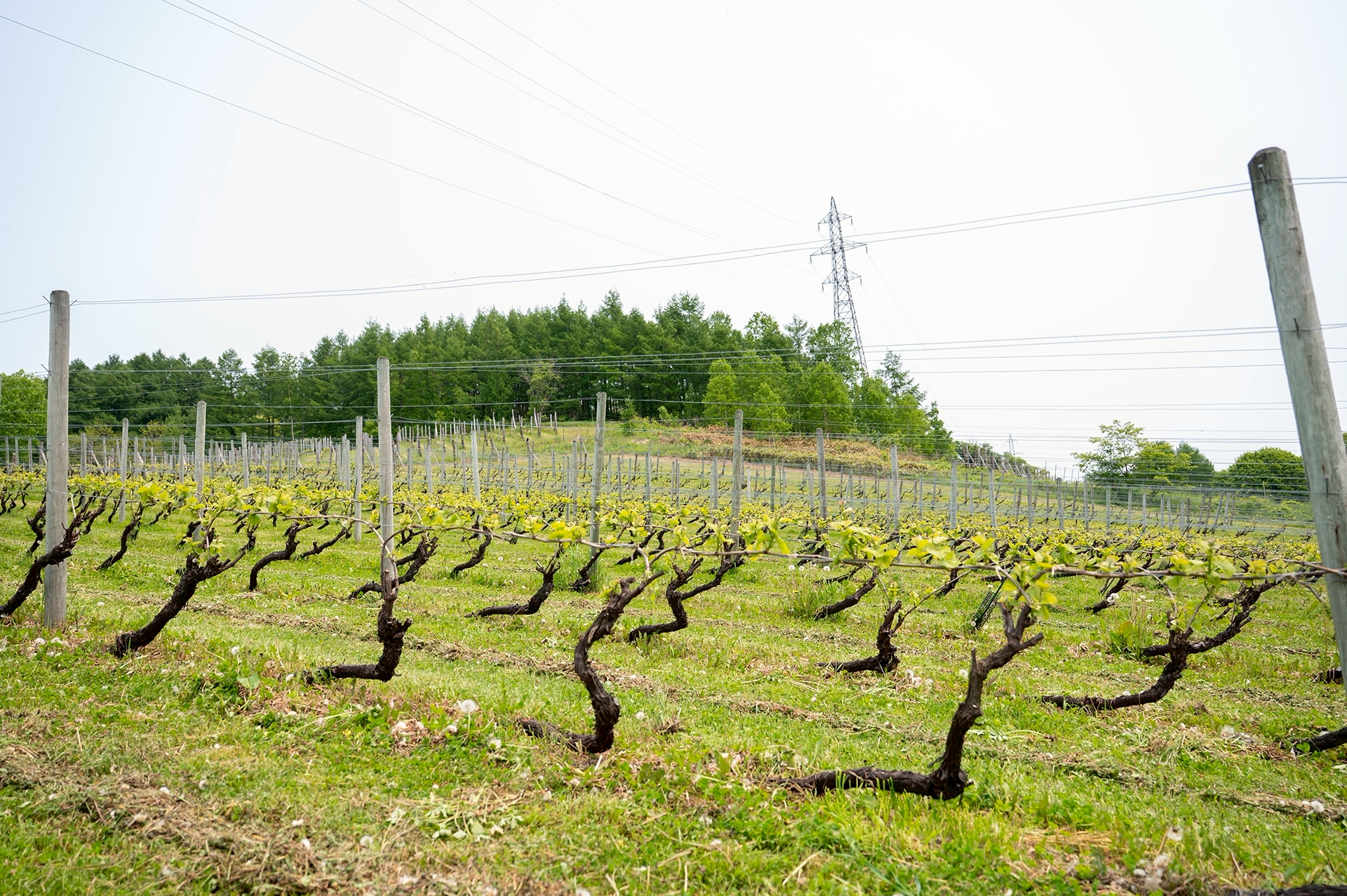
Mikasa is an inland city with a wide diurnal temperature range, which becomes even more pronounced after mid-August.
During the day, the vines photosynthesize effectively to build sugar levels, while the cool nights preserve acidity. The balance between the rate of sugar accumulation and the retention of acidity is said to be exceptional.
As a result, the grapes retain vibrant acidity while achieving good sweetness, which also enhances their aroma. This is how high-quality grapes are grown.
On the flip side, the stress on the vines leads to lower grape yields, which presents a challenge from a business perspective.
"But in the end, I still want to grow grapes with rich, full flavor, even if the yield is small," maintaining a steadfast commitment to quality.
CHAPTER 02
Get to know the wines of TAKIZAWA WINERY!
Now, hearing about the grapes in the vineyard has surely raised your expectations for the wine.
In this second part, Mr. Kageyama introduces us to Takizawa Winery's winemaking and their wines.
Takizawa Winery's annual production is approximately 25,000 to 27,000 bottles.
They offer three series of wines.
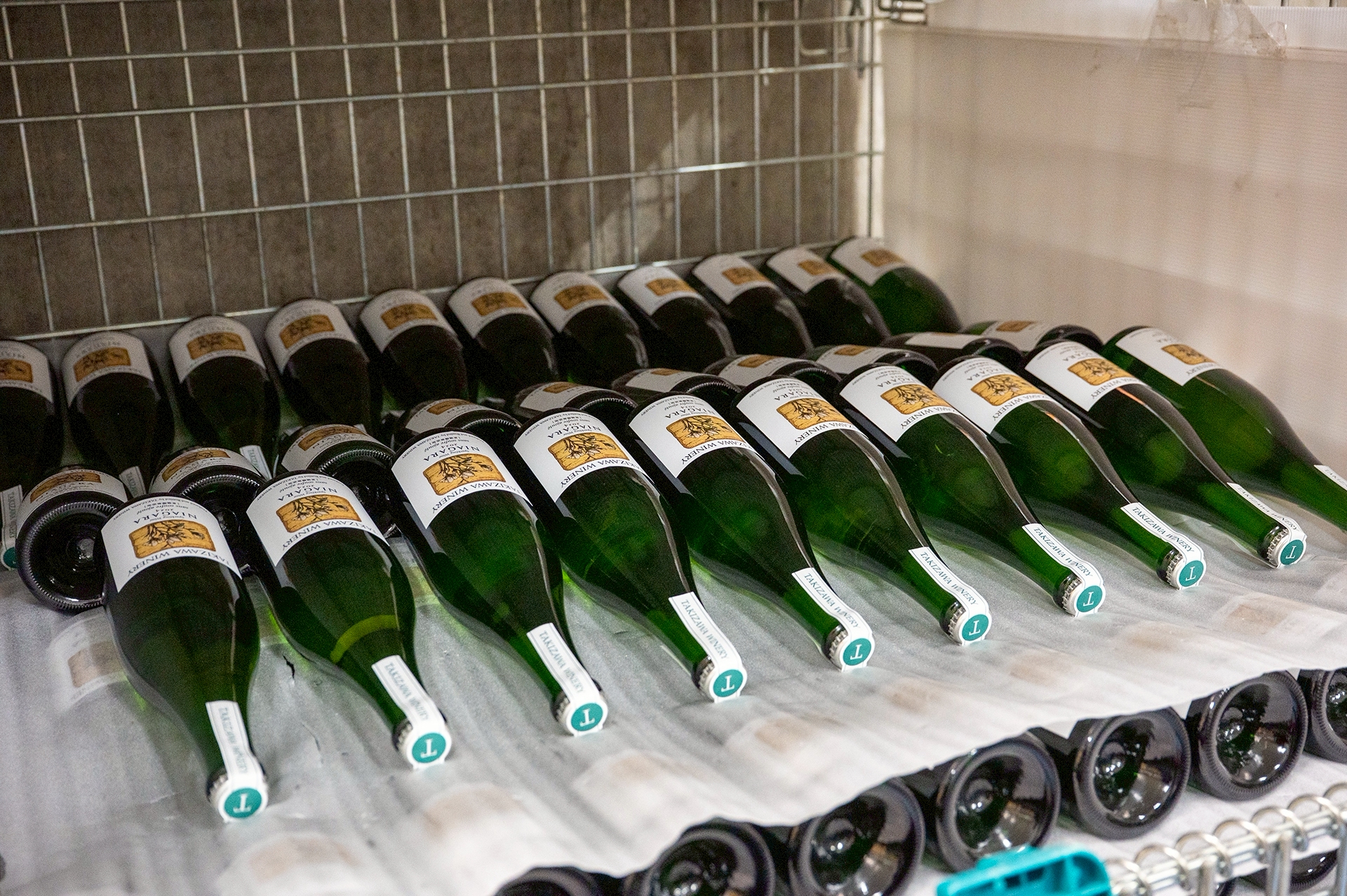
First, introduced with the wish, "We want people to drink it casually as a table wine!", are those made from grapes purchased from the agricultural cooperative in Yoichi:NiagaraandTabiji.
He mentions, "I want people to enjoy it like an after-work beer," and a well-chilled Niagara with crisp acidity certainly sounds perfect for the coming season.
Next is their second line, made from grapes purchased directly from contract farmers in Yoichi and Iwamizawa. These wines are made from grapes grown with great care and attention to viticulture!
And finally, the wines made from estate-grown grapes.
Currently, the Sauvignon Blanc 2020 Reserve is available for purchase.
He had long discussed with former president Mr. Takizawa, "We want to age them properly ourselves and sell them when they reach their optimal drinking window." Carrying on that vision, they released the 2020 Sauvignon Blanc and Pinot Noir (now sold out).
What does it taste like!? "Unusually for a Sauvignon Blanc, it features distinct grain-like notes and aromas of white truffle. Yet it also retains acidity and a sense of minerality." What an intriguing comment!
Incidentally, this site was an ancient seabed, and digging here yields many ammonite fossils.
And of course, one can't help but be curious about the Pinot Noir from this terroir.
Although the 2020 vintage is currently sold out, they plan to age the Pinot Noir from "Yo no Hatake" (Sun Vineyard)—said to be their most blessed plot—for about 5 to 7 years before releasing it, and it is currently being carefully stored.
CHAPTER 03
In Conclusion
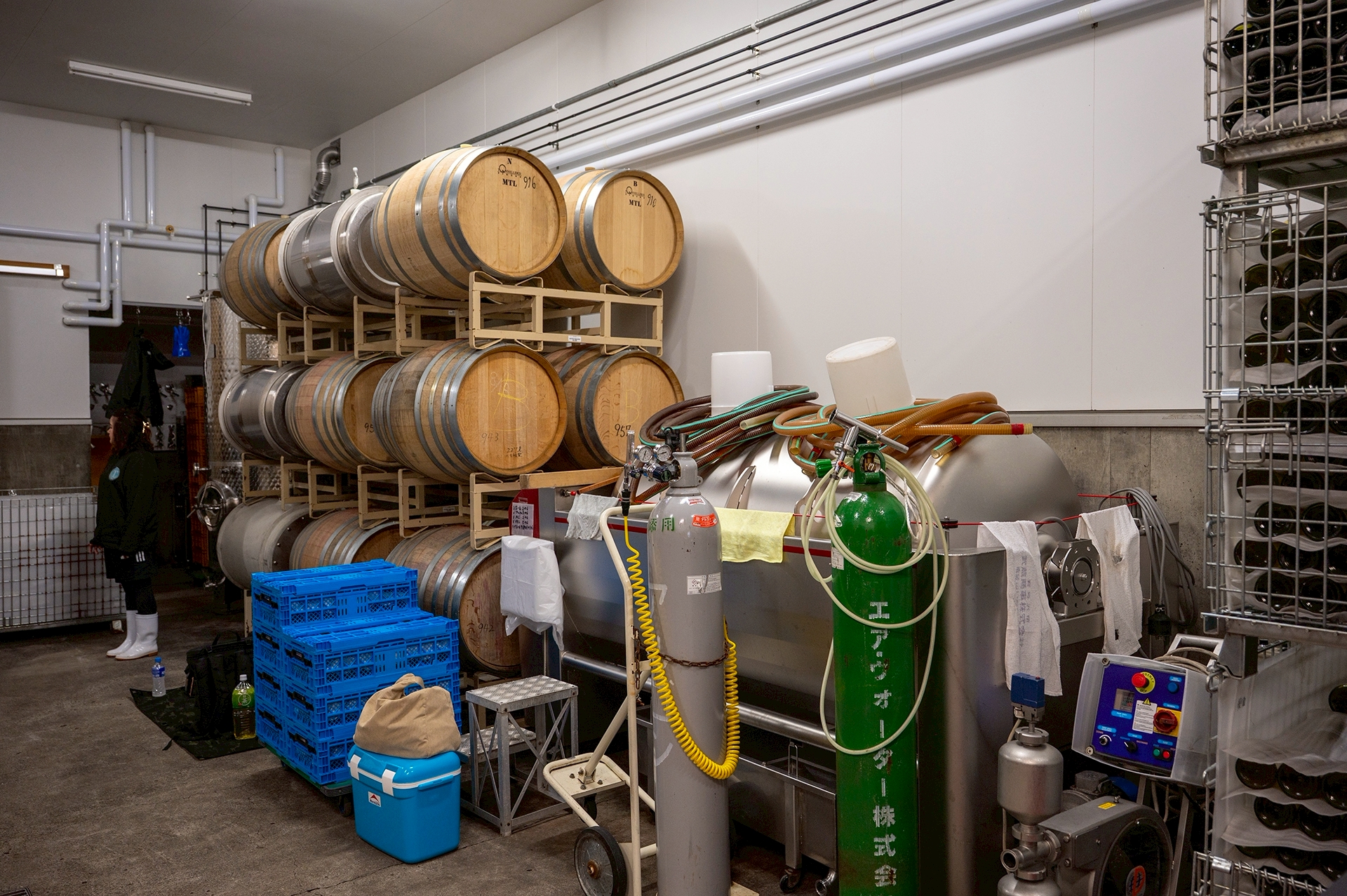
"I truly believe we are blessed with the climate here. We can produce grapes with an exceptional balance of sugars and acidity," he says. These prized grapes are fermented with wild yeast, and malolactic fermentation (MLF) is also conducted using indigenous lactic acid bacteria.
In the past, founder Mr. Takizawa remarked, "We aim to make wine that is powerful and full of vitality—wines that draw out the natural strength of Hokkaido as much as possible."Seeing how Mr. Kageyama respects this land, maximizes its charm, and shares its story, I feel that his predecessor's vision has truly been passed down to him.
On the day of my visit for the interview, subcontracted workers from a social welfare facility in Mikasa City happened to be labeling bottles.
While preparing upbeat background music and asking, "What song should we play today?" as he explained the day's tasks, all the staff seemed to thoroughly enjoy interacting with Mr. Kageyama.
Scenes like this, too, are surely part of the legacy carried on as "winemaking that brings out the maximum charm of the region."
About the author
Stories covering the same region, newest first.
- WINERIES【Exclusive Interview with Takahiko Soga of Domaine Takahiko】“There Are Wines That Can Only Be Made in Japan” — Takahiko Soga on Nature, Deliciousness, and the Future of Japanese Wine3 AUG 2026Miyuki Isobe
- KNOWLEDGEBlind Tasting Has No Single Right Answer?! Asia’s No. 1 Sommelier Reeze Choi on How to Discover What You Like13 JUL 2026Miyuki Isobe
- WINE & DININGSouth American Memories Meet Fine-Dining Technique at unito in Nakameguro — with Exceptional Sparkling Wines from Hirakawa Winery20 MAR 2026Miyuki Isobe
- WINERIESFrom a Winery in Manriki, Yamanashi: Cave an’s Winemaking That Has Mastered the Basics12 DEC 2025Miyuki Isobe
- WINERIESA Journey Embracing Time: The "Stay-Style Winery Experience" at Niki Hills14 SEP 2025NORIZO
- WINE TOURISMA Festival Touring Yoichi's Wineries: Open Farm Festival "La Fête des Vignerons" 20257 SEP 2025NORIZO
Wineries in this region
REGIONAL WINERIESRead → Know → VisitWineries in 北海道. Find somewhere to visit.