
WINE & DINING
South American Memories Meet Fine-Dining Technique at unito in Nakameguro — with Exceptional Sparkling Wines from Hirakawa Winery

unito is a popular Italian restaurant on the Meguro River in Nakameguro. Japanese wine is served here too, and the only Japanese producer currently on the list is Hirakawa Winery in Yoichi, Hokkaido. Whenever Chef Kensuke Okano encounters an ingredient or wine that genuinely moves him, his instinct is to visit the producer, dig deeper, and bring what he learns back into his own culinary world. A few years ago, the moment he tasted a wine from Hirakawa Winery, he knew he had found something special—and soon afterward, he went to visit the winery himself.
CHAPTER 01
Italy and South America, Connected at unito
Chef Okano trained in Italy for around five years, but he was born in Venezuela. His roots, memories from his years of training, the techniques he has refined in Japan, and his own interpretation of ingredients all come together to shape both the cuisine and the atmosphere of this wonderful restaurant.
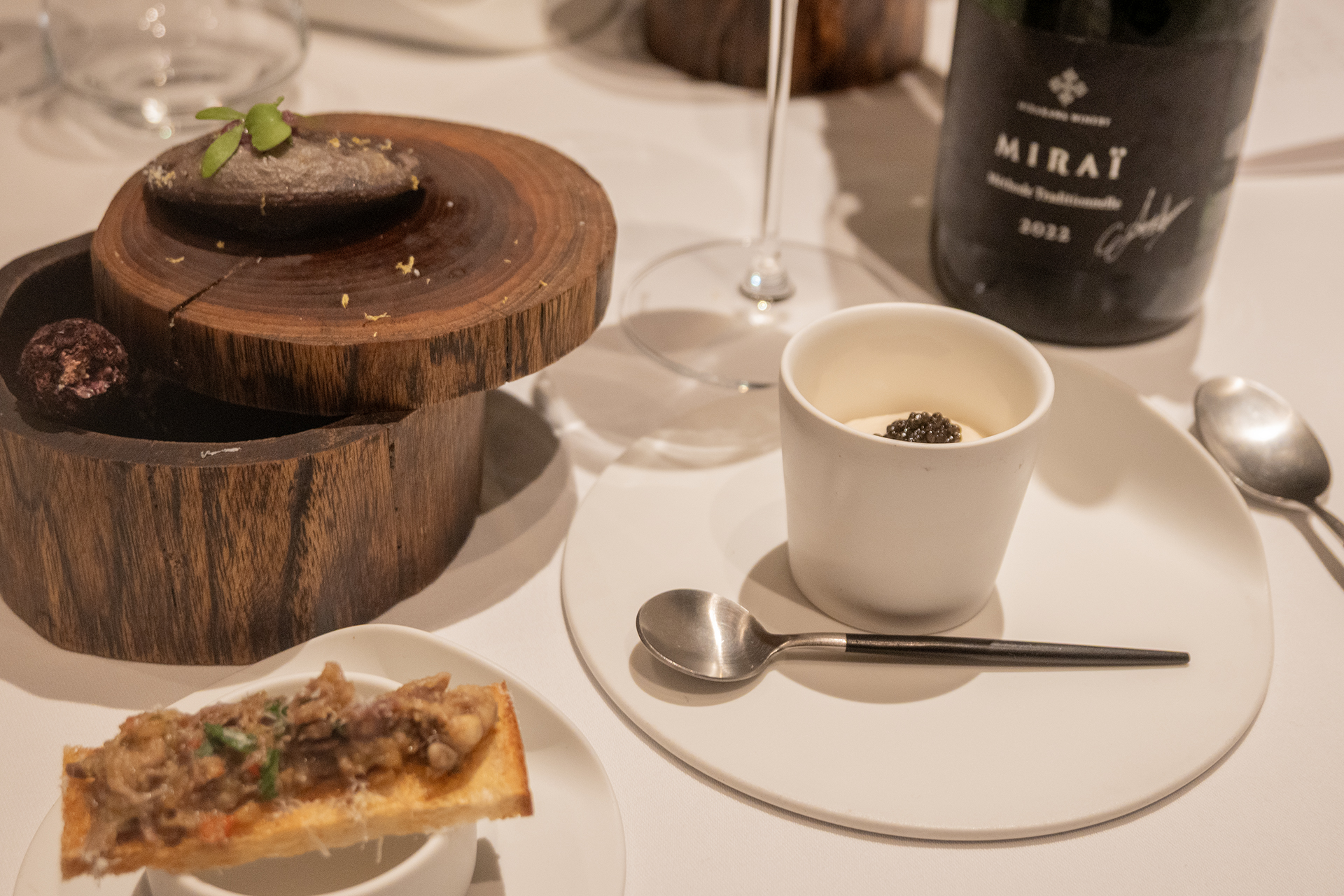
We began with three small appetizers.
Arranged on a wooden plate were a Venezuelan cornmeal dough called arepa, filled with octopus and potato salad, fried, and served with purple olive paste; a mousse of new-season onion and coconut milk topped with caviar; and bruschetta with carne mechada, a Venezuelan-style shredded beef stew scented with cumin.
The presentation is vivid and playful, yet the flavors themselves are polished and precise.
The sparkling wine paired with these dishes was “Miraï,” Miraï Méthode Traditionnelle 2021 (white sparkling). It has a gentle fruit-derived sweetness, silky and finely textured bubbles, and enough presence to work not only as an aperitif but as a true wine for the table. It undergoes four years of secondary bottle aging on the lees, building both finesse in the mousse and savory depth. Hirakawa says, “It pairs with a wide range of dishes, from raw seafood and herb-driven cuisine to shellfish, chicken, pork, and even white-rind cheeses.” Tasting it here, I could immediately see what he meant—and it made me even more curious about the pairings to come.
Next came a warm salad-style dish combining spring vegetables such as nanohana, broad beans, and snap peas with Parmigiano mousse, guasacaca—a Venezuelan avocado sauce—quail egg, and herbs.
Alongside it was kibbeh, the Brazilian street food, here prepared with nanohana.
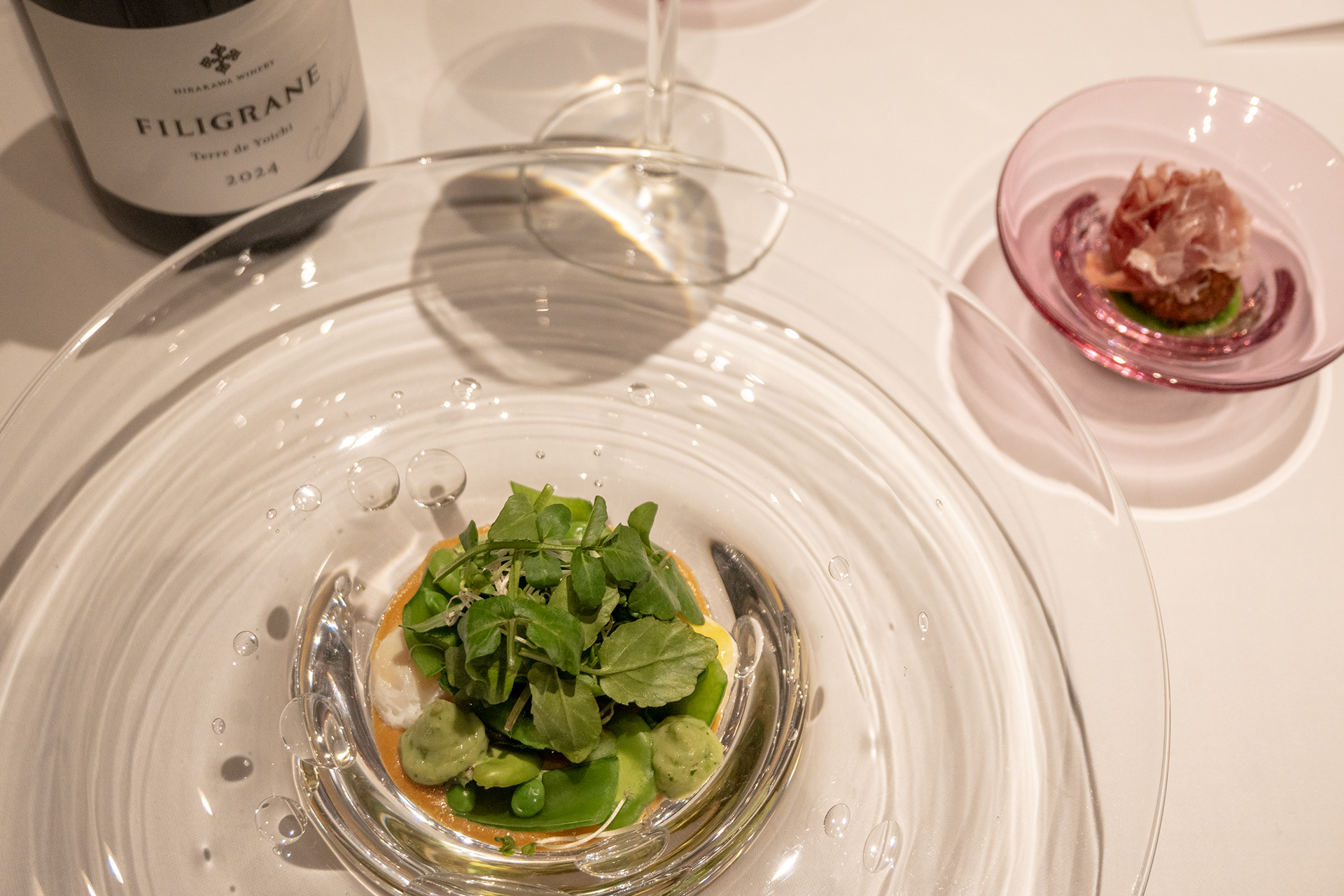
The dish had the lightness of spring, the pleasant bitterness of beans and greens, and the bright lift of herbs. Its delicate appearance gave no hint of how layered the flavors would be—a very welcome surprise.
The white wine here was Filigrane Terre de Yoichi 2024. Beyond citrus and green notes, it showed aromas reminiscent of fennel, anise, and white pepper, together with a flinty minerality. The satisfying fruit and a faint saline edge paired beautifully with the earthy sweetness of the vegetables.
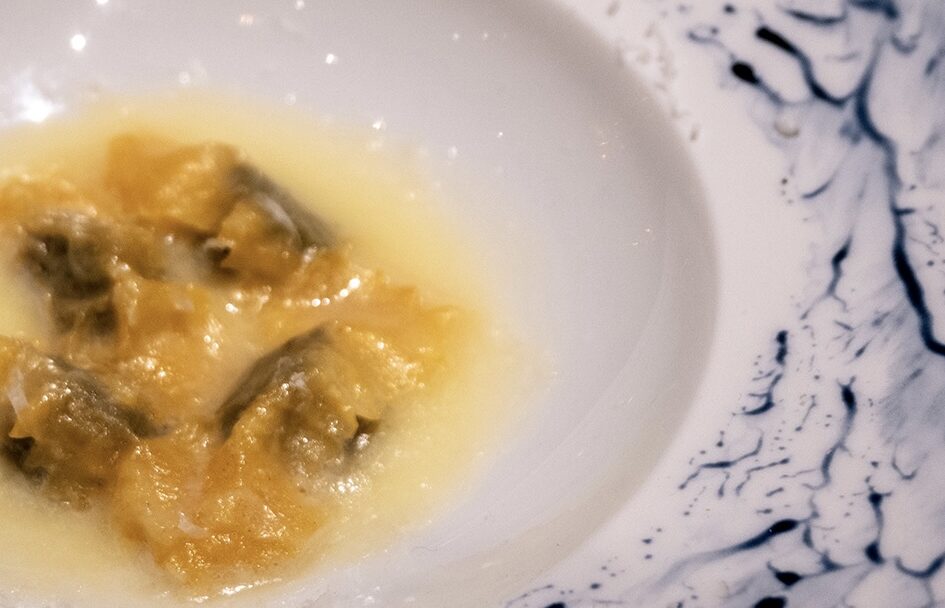
Midway through the course came what could be called one of the chef’s signatures: agnolotti del plin.
Chef Okano has been working with this ravioli since his training days in Piedmont, refining it for Japanese water, ingredients, and humidity. The filling layers beef, pork, rabbit, sausage, and several vegetables to build remarkable depth of umami. The pasta dough is made with Italian flour and carefully selected eggs, then rolled so thin that the pasta machine settings are nearly at their limit.
I was equally surprised to learn that the butter for the sauce is made by hand every morning from fresh cream.
The pasta is impossibly thin and delicate, while the filling is deeply concentrated. It glides across the palate, releasing rich umami, yet remains wonderfully light because of how finely the dough has been rolled.
It was so smooth and melting that the phrase “pasta you could drink” slipped out before I knew it.
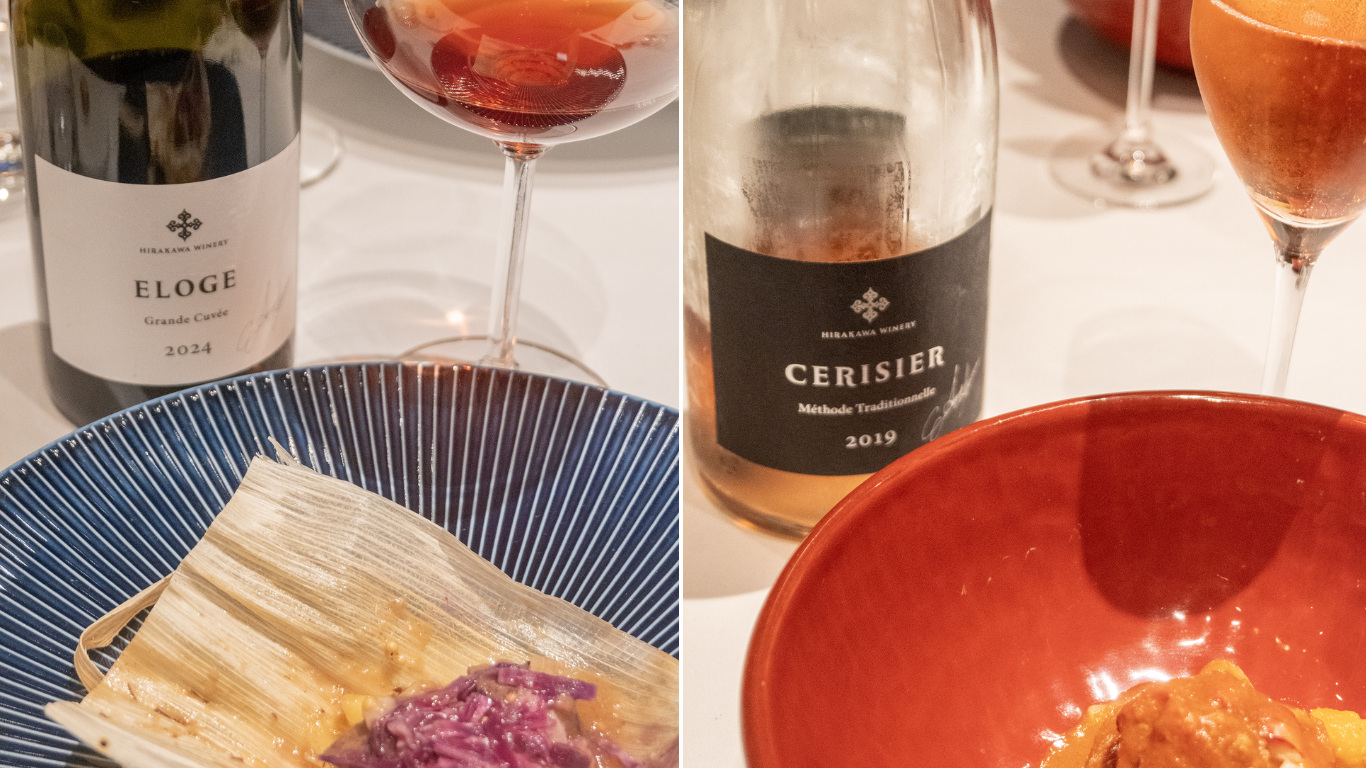
At this point, the rosé sparkling “Cerisier,” Cerisier Méthode Traditionnelle 2019 (rosé sparkling), made its appearance.
Six years of aging bring deep toastiness, precision, and a firm core of savoriness. The wine embraces the dish’s fragile pasta texture, pure umami, and richness of butter without overpowering any of them. Its finely textured bubbles keep everything lifted.
It was the kind of pairing that reminded me once again what it means for a wine to truly come alive at the table.
And this agnolotti del plin happens to be a favorite dish of Atsuo Hirakawa, the winemaker himself. Hirakawa also has a sommelier’s perspective, and this is a pairing he personally fell for. I strongly recommend experiencing it at least once.
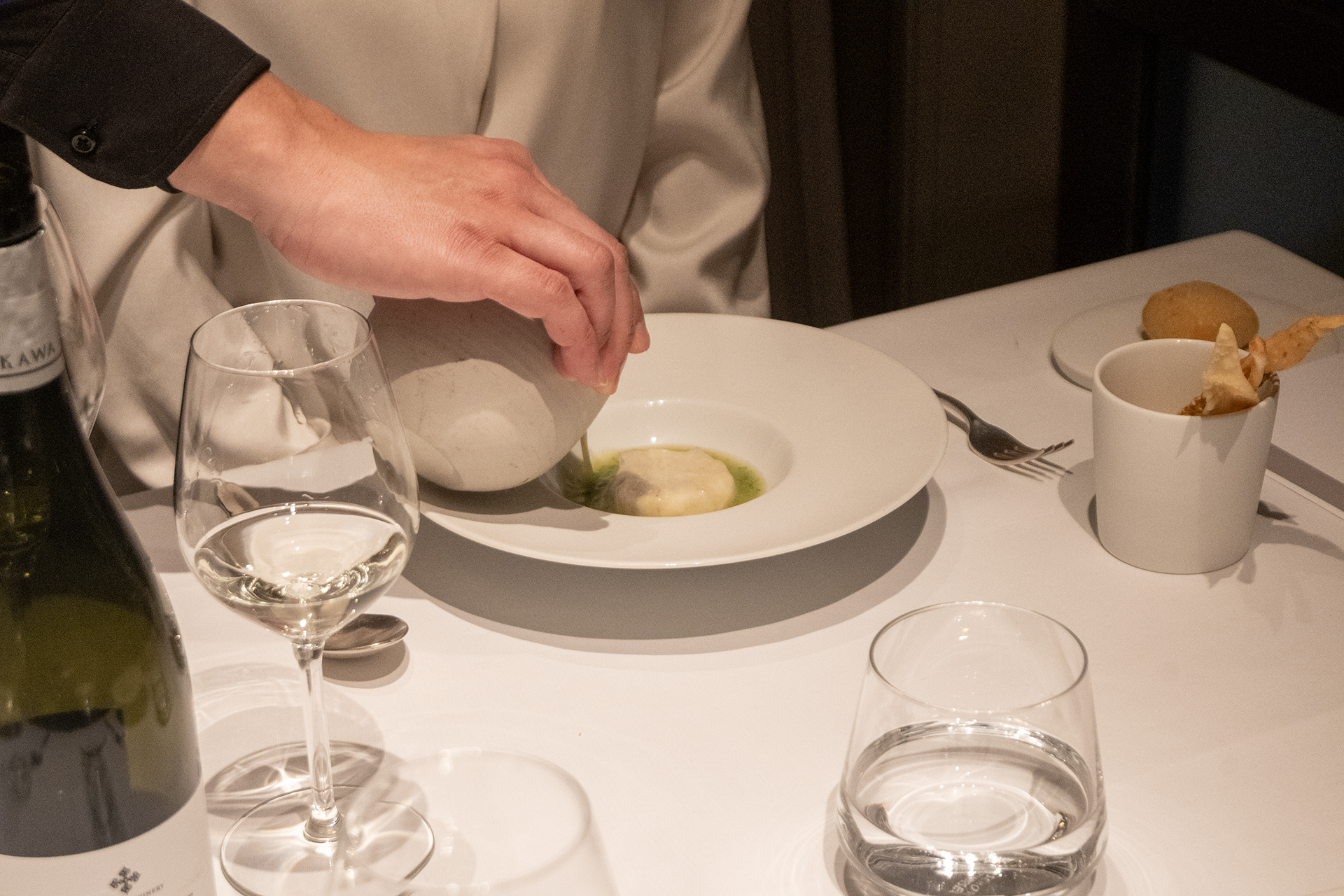
The course continued with dishes such as braised beef tongue and polenta steamed in corn husks, as well as linguine dressed in a deeply concentrated tomato sauce.
Each dish carries an unmistakable South American accent, yet remains firmly grounded in Italian cuisine. That balance makes Chef Okano’s originality especially clear.
For the main course, guinea fowl was lightly coated with egg, roasted, and perfumed with banana leaf, then served with confit Shimonita leek. The scent of banana leaf connects directly to the chef’s childhood memories in Venezuela. What feels distinctly unito is the way he treats Japanese ingredients with great care while weaving in aromas from his South American background. The meat was moist yet pleasantly firm, with both savoriness and delicacy in every bite.
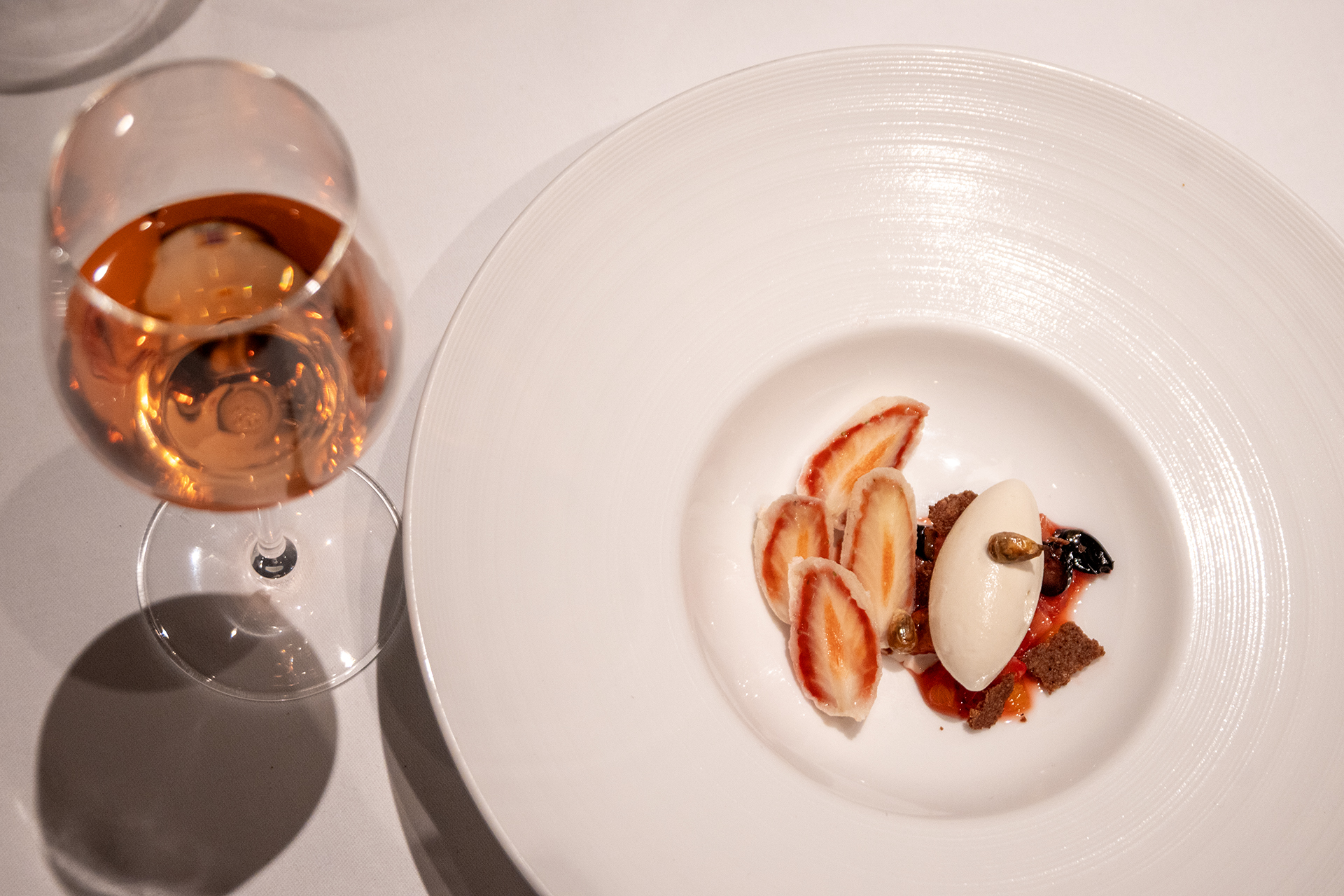
For the strawberry dessert, the rosé sparkling “Cerisier” Cerisier Méthode Traditionnelle 2019 (rosé sparkling) returned—the same wine we had enjoyed with the agnolotti del plin and the lobster linguine. Several other wines appeared in between, but from the opening toast all the way through dessert, the versatility of “Cerisier” was outstanding.
CHAPTER 02
A Wine Judged by How It Lives with Food
What struck me most strongly through this pairing was how comfortable and complete a meal can feel when both the cuisine and the wines have been created with the same question in mind: how should this live at the table?
I was reminded firsthand that “being able to enjoy an entire bottle” and “not becoming tiring to drink” are themselves meaningful measures of wine quality.
The wines were expressive but never loud, elegant in the way they stayed beside the food. The cuisine, meanwhile, absorbed techniques and cultures from abroad while remaining unmistakably individual. When the two met, the table felt complete. It is an experience well worth having at least once.
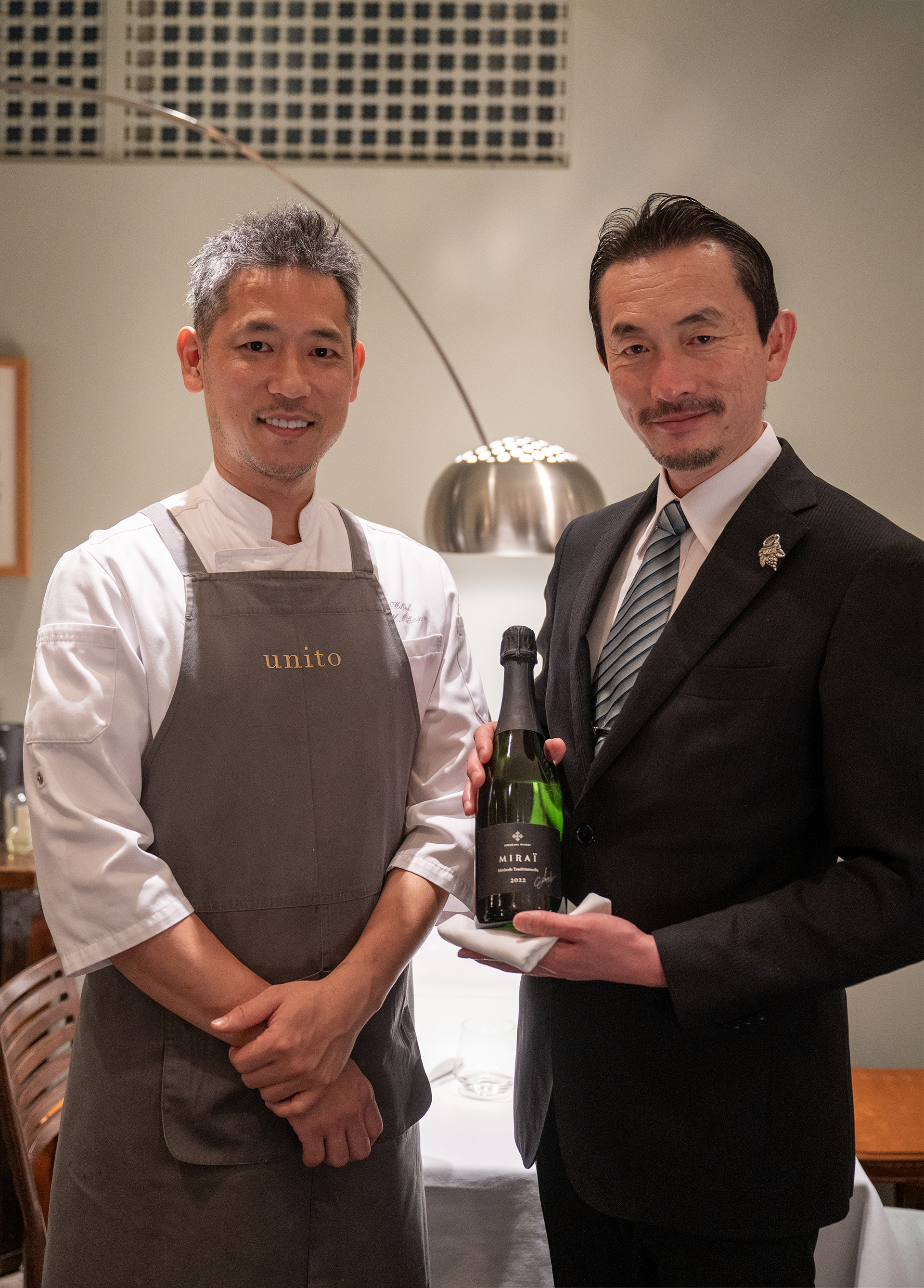
(From left) unito Chef Kensuke Okano and Hirakawa Winery President Atsuo Hirakawa
【unito】
https://www.unito.tokyo/
From the dining room, which sits along the Meguro River—one of Tokyo’s best-known cherry blossom spots—you can enjoy a beautiful view of the trees in full bloom.
The restaurant is especially popular during cherry blossom season each year, so early reservations are highly recommended.
【Hirakawa Winery limited wines can be purchased here】
https://craftwineshop.com/products/diners202601?variant=55186498453672
About the author
Stories covering the same region, newest first.
- WINERIES【Exclusive Interview with Takahiko Soga of Domaine Takahiko】“There Are Wines That Can Only Be Made in Japan” — Takahiko Soga on Nature, Deliciousness, and the Future of Japanese Wine3 AUG 2026Miyuki Isobe
- KNOWLEDGEBlind Tasting Has No Single Right Answer?! Asia’s No. 1 Sommelier Reeze Choi on How to Discover What You Like13 JUL 2026Miyuki Isobe
- WINERIESFrom a Winery in Manriki, Yamanashi: Cave an’s Winemaking That Has Mastered the Basics12 DEC 2025Miyuki Isobe
- WINERIESA Journey Embracing Time: The "Stay-Style Winery Experience" at Niki Hills14 SEP 2025NORIZO
- WINE TOURISMA Festival Touring Yoichi's Wineries: Open Farm Festival "La Fête des Vignerons" 20257 SEP 2025NORIZO
- WINERIESBringing Refreshing Relief to Sweltering Days! Delivered from Heavy Snow Country: Housui Winery23 JUN 2025Miyuki Isobe
Wineries in this region
REGIONAL WINERIESRead → Know → VisitWineries in 北海道. Find somewhere to visit.