
Hokkaido ranks third nationwide in wine production volume. The number of wineries has now increased to 66.
Its popularity over the past few years is surely something any wine lover knows.
A seminar was held where participants could learn about the "present state" of Hokkaido wine, presented by Masahisa Abe, Representative Director of the NPO Wine Cluster Hokkaido.
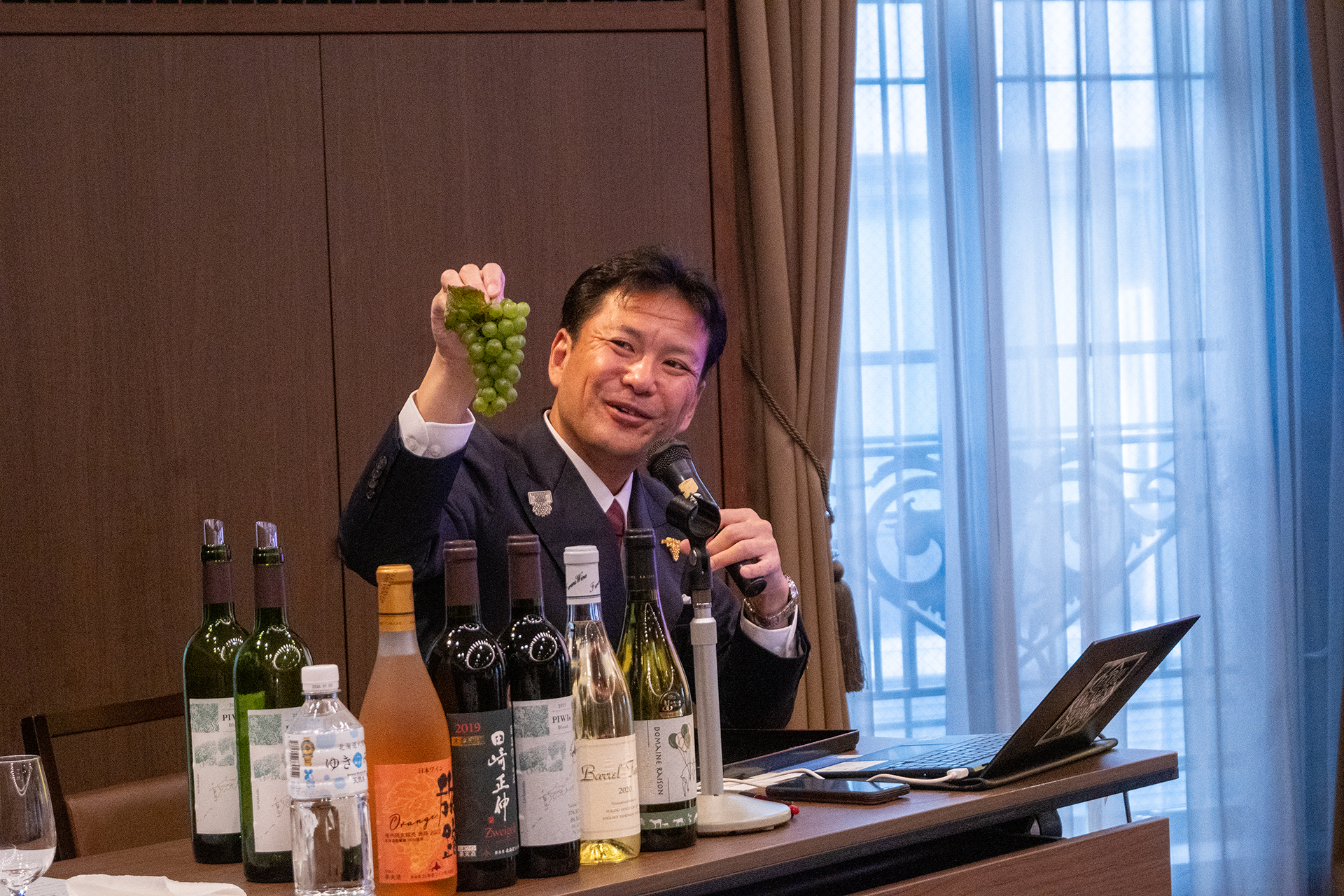
Transitions in Climate and Grape Varieties
When it comes to varieties in Hokkaido, many people likely think of German varieties typical of cool climates.
Bacchus, Müller-Thurgau, Kerner, Seyval... However, as is well known, global warming is no exception for Hokkaido.
The wine belt has shifted, making it possible to produce wine up to latitude 44 degrees north, and changes in cumulative temperatures in Yoichi Town have been particularly noticeable since 2000.
Furthermore, because the amount of snowfall differs between east and west, the varieties and wine styles focused on also differ by area.
Overall, there has recently been a trend of shifting from German white varieties to French white varieties (Chardonnay and Sauvignon Blanc).
Regarding reds, Zweigeltrebe has achieved steady success, and efforts are also being put into the proprietary development of cold-hardy varieties (such as Yamasachi, Kiyomai, and Furano No. 2).
Looking ahead to global warming, the commercialization of Syrah and the introduction of Spanish varieties have reportedly begun.
In addition, some are promoting the individuality and stories of local varieties (Tabiji, Yamasachi).

PIWIs Becoming Established
Pronounced "pee-vee," they have been drawing attention in recent years.
It is an abbreviation of the German "Pilzwiderstandsfähige Rebsorten," meaning "fungus-resistant grape varieties."
They are hybrid varieties bred by crossing American or Asian grapevines, which possess strong resistance to pathogens, multiple times with European grapevines (Vitis vinifera), and their defining characteristic is resistance to grape diseases such as powdery mildew, downy mildew, and gray mold (Botrytis).
Therefore, they offer the advantage of reducing pesticide spraying by as much as roughly 80%, and furthermore, high hopes are placed on these varieties as an aid to sustainable winemaking through cost reductions in labor and consideration for the global environment.
In Hokkaido, some are beginning to put effort into initiatives with these PIWIs.
A Remarkable Feat for Hokkaido Wine at the "Japan Wine Competition 2024" (Japanese wine competition)
In recent years, the overall quality has been improving, with wines winning gold medals at the Japan Wine Competition (Japanese wine competition).
This year, marking the 20th year of the competition, the top prize "Grand Gold" was established.
European white wines from Hokkaido won this Grand Gold (one of only two nationwide) and six Gold medals.
Domaine Raison / Nakafurano Sauvignon Blanc 2023
Hokkaido Wine / Tazaki Vineyard Sauvignon Blanc 2022
Hokkaido Wine / Kitajima Vineyard ~No.7~ Kerner 2020
Hokkaido Wine / Yoichi Harvest Kerner Special Cuvée 2021
Chitose Winery / Kita Wine Kerner Late Harvest 2021
Chitose Winery / Kita Wine Kerner Dry 2023
Housui Winery / RICCA Chardonnay 2023
Available for Purchase Here! Award-Winning Japanese wine Competition Wines
Japan Wine Competition 2024 (Japanese wine competition) Award-Winning Wines
Why not try and taste these increasingly evolving recent Hokkaido wines?