
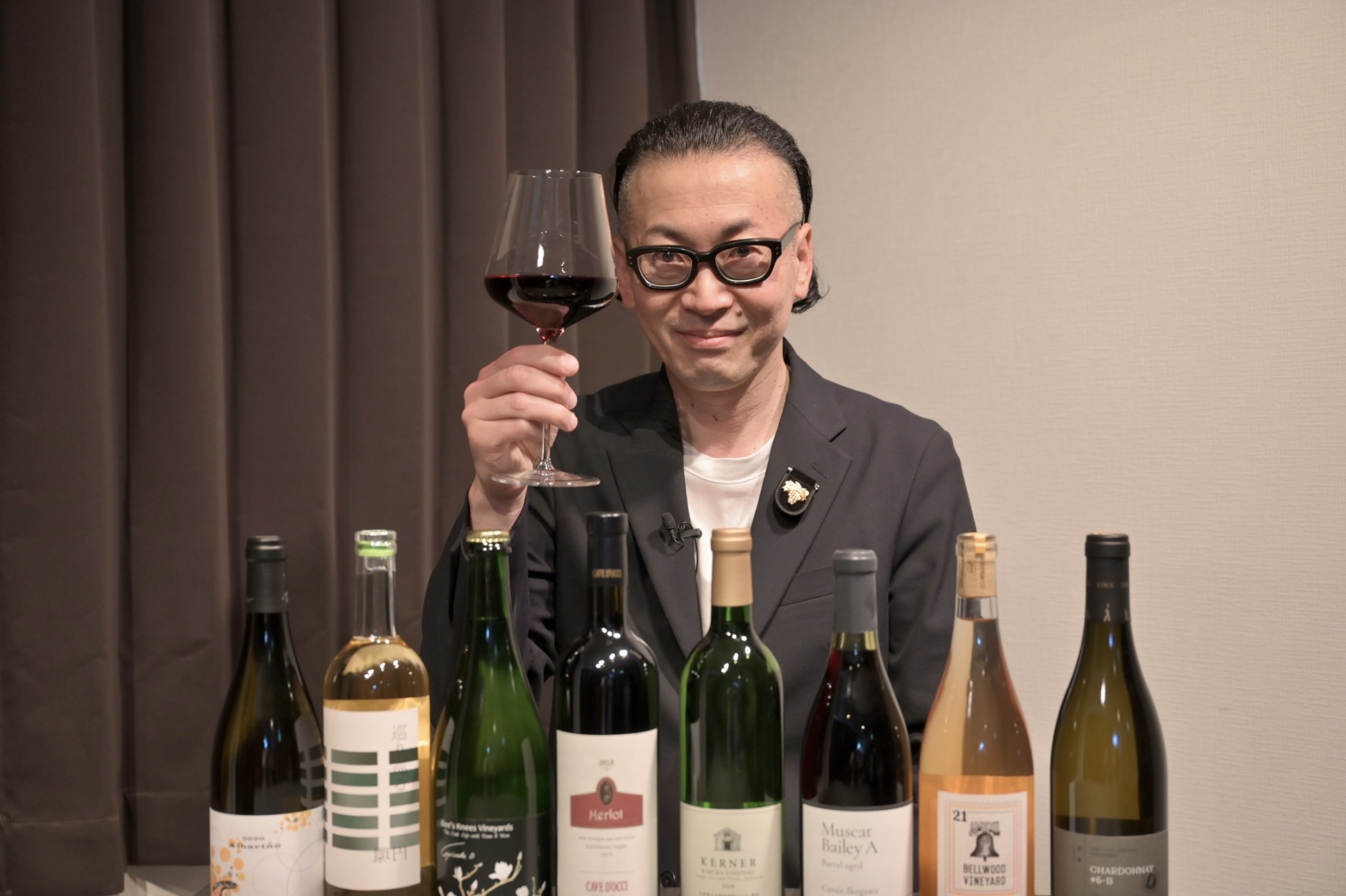
In this section, we focus on people working to revitalize the Japanese wine scene and those contributing to the popularization of Japanese wine, introducing their specific activities and connection to wine.
For our first installment, we interviewed Higuchi-kun, who works as a comedian and was recently appointed as a "Yoichi Town Wine Ambassador"!
Please tell us what got you "hooked" on Japanese wine.
There was a Japanese wine event called "LIFE with WINE," and I was invited as a guest for its 10th iteration (held in February 2017). They asked me to "do 'Renaissance!'"
By the way, I'm actually the one who doesn't say "Renaissance!" (laughs).
After finishing my segment smoothly, having just earned my Wine Expert qualification at the time, I visited every booth with great interest.
That's where I encountered a certain wine.
On top of that, the winemaker explained to me that Japanese wine is characterized by its "umami" and "dashi-like" qualities, and that its delicate flavors pair wonderfully with Japanese cuisine.
From that point on, I was hooked on Japanese wine.
——By the way, what was that wine?
It was a Pinot Noir wine from Yoichi Town, Hokkaido.
Up until then, I had hardly ever drunk Japanese wine. Or rather, I actually hadn't drunk much wine at all.
—And yet you earned the Wine Expert certification?
That's right (laughs).
I obtained my Wine Expert certification in 2015.
Because we do a comedy routine called 'aristocratic stand-up' where we toast with wine glasses,
we had been invited to Beaujolais Nouveau release events for years.
One year, we were invited to a somewhat formal Beaujolais Nouveau party attended by people from the French Embassy,
and for the first time, someone asked me, 'How does this year's Nouveau taste?'
Until then, most of our gigs were fairly casual events at supermarkets or shopping malls, where nobody had ever asked me for that kind of commentary (laughs).
Thinking I had to say something that sounded legitimate, I blurted out an off-the-mark comment like, 'Well, this year's wine is really heavy,' and the atmosphere turned completely awkward.
Thinking I really needed to study a bit, I hurriedly enrolled in a school and obtained my Wine Expert qualification.
That became the catalyst, which led to me being invited to 'LIFE with WINE.'
—Everyone has their own motivation for starting to study wine, but Higuchi-kun's case is quite unique.
That might be true.
Even when I went to wine school, I didn't understand anything at first.
To the point where I couldn't even say 'Cabernet Sauvignon.' I kept mispronouncing it as 'Carbenet,' and people were constantly pointing it out.
At wine school, most people are already familiar with wine and have some prior knowledge,
but I didn't understand anything right from the very first line of the textbook, so it was quite a struggle.
What kind of activities do you do regarding Japanese wine? Please tell us about your involvement with Japanese wine from when you first started up to the present.
Occasionally, I introduce wineries on location shoots for TV shows, and in 2019 I gave a lecture at Fukushima University.
Gratefully enough, it was the third year of that lecture series: the first year was Shinya Tasaki, the second year was Takuro Tatsumi, and then for some reason, the third year was me (laughs).
It was a bit pressuring, but I had the opportunity to speak in front of university students on the theme 'The Present State of Japanese Wine'.
Besides that, I've served as a sensory panel judge for the Nagano Prefecture Designation of Origin Control Committee / GI Nagano, as well as a judge for the Japan Winery Award in 2021 and 2022.
Personally, I run an online salon called 'Higuchi-kun's Japanese Wine Club.'
We used to hold in-person wine gatherings once a month as offsite meetups, but once the COVID-19 pandemic hit, we switched to remote wine gatherings using Zoom,
and we recently passed our 110th session.
For 'Wine Kingdom,' I've had the chance to contribute to a series called 'The ABCs of Grape Varieties' and have been invited to wine events;
thankfully, I've been given opportunities to do a wide range of work.
—You are active across a wide range of fields, from approachable events to academic work.
No, no, it doesn't feel academic at all when I'm involved.
—No, but Sensei...
No, no, I'm no sensei (laughs). I'm still in the middle of learning.
—What is the online salon like?
At our weekly remote wine gatherings, I chat with the winemaker while drinking their winery's wine together with our members,and then we have a question-and-answer session.
It lasts about 90 minutes.
We started this after the COVID-19 pandemic began, and we've been doing it almost every week.
Usually, when you go on a winery tour, the things they explain are somewhat set,
but what makes remote wine gatherings unique is that because the winemakers are drinking too, you get to hear quite a few 'off-the-record' stories.
I think that's really interesting.
So I learn a lot from these remote wine gatherings too.
Drinking wine while listening to explanations from the winemakers themselves is a truly luxurious time.
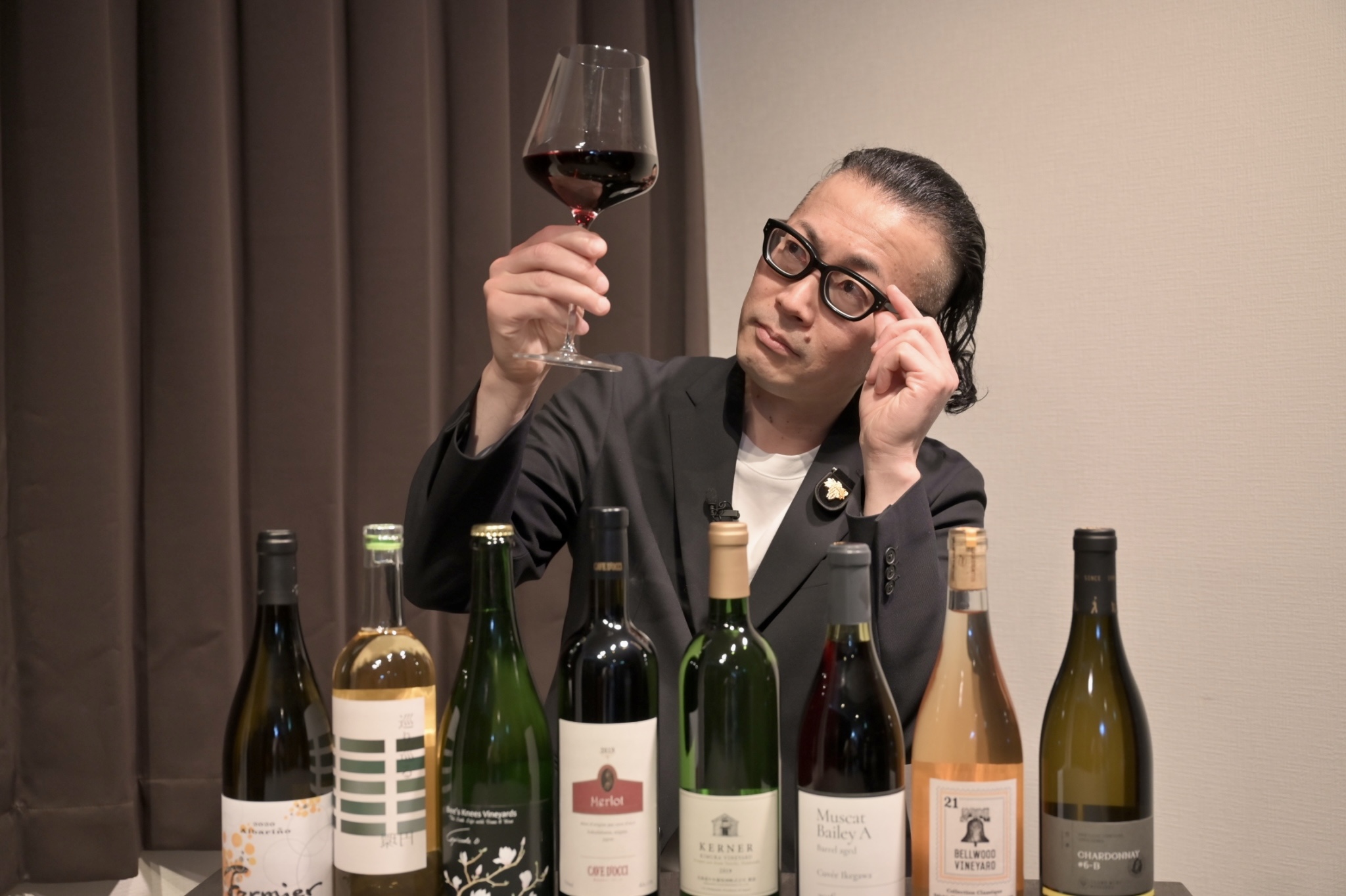
What are your thoughts on the current state and future of Japanese wine?
Currently, there are over 400 wineries in Japan, but I feel like the number of drinkers hasn't grown that much.
Even when attending Japanese wine events, I don't see many new fans.
I would love for people who haven't tried it yet to discover its appeal.
I used to be the same way, but I think people simply don't know where to buy Japanese wine.
So if it were available at convenience stores, supermarkets, or local liquor shops, or if more casual izakayas and bars served it,
I hope wine culture will gradually take deeper root.
For example, there are quite a few Koshu wines in the 1,000-yen range, but due to limited production quantities, it's hard to come across them unless you actively look.
You can buy them online, but I feel like that is still a bit of a high hurdle for wine beginners.
If there were more accessible places where people could drink Japanese wine, they could try it there first, and if they think it's delicious,
it might start spreading more widely, encouraging them to buy it online next time.
In that sense, I feel that the broader the entry point, the better.
Could you share any recommendations on how to enjoy Japanese wine?
Depending on the COVID-19 situation, my first recommendation would be to visit a winery.
You get to listen to the winemakers and grape growers, and then taste their wine.
Wine tastes vastly better when you drink it after hearing the story behind it, so I think experiencing that once will help people enjoy it even more.
Especially so with Japanese wine.
I don't speak English or French, so at overseas wineries, I listen to the explanations translated by an interpreter and think, 'Ah, I see,'
but you can't really get a sense of the winemaker's personality.
At Japanese wineries, though, you can naturally picture the winemaker's personality and think, 'Ah, so that's why it tastes like this—because this person made it!' (laughs).
I think that, too, is a way of enjoying wine unique to Japanese wine.
—That's true; wines from places you've visited yourself leave you with a lasting sense of affection or personal attachment, don't they?
In that sense, if you have the opportunity to help out with the harvest or other tasks, that emotional connection becomes even stronger.
The pairing of Japanese cuisine and Japanese wine is the ultimate combination, so I highly recommend enjoying a wine you brought back from a winery alongside your home-cooked meals.
—It really becomes a familiar, accessible presence that you can enjoy in your daily life.
What kind of activities would you like to pursue in the future to help promote Japanese wine?
I was recently appointed as a Yoichi Town Wine Ambassador, and Mr. Koji Kimura from Kimura Farm in Yoichi Town's Nobori district has been teaching me the year-round process of growing wine grapes.
Without getting in the way, of course, I am able to view the vineyard and assist with the work.
I hope to share the year-long process of grape growth through social media and other channels.
It is often said that '80% of a wine's quality is determined by the raw grapes.'
Since you can't make delicious wine without good grapes, I'd love to show people that story starting right from the grapes themselves.
—It's wonderful that you don't just enjoy wine, but also take the time to experience and learn directly from grape cultivation yourself.
Not at all. Although the staff at the local town hall were almost taken aback, asking me, 'Aren't you being a bit too hardcore about this?' (laughs).
I just really wanted to go, so I asked if I could.
The other day, they taught me how to do debudding on Pinot Noir vines, but it was really hard to get right.
I mean, these are Pinot Noir vines from *the* Kimura Farm! If you remove too many buds, the yield drops, but if you leave too many, that's no good either.
—That sounds like a huge responsibility.
It really is. Of course, other tasks are important too, but debudding determines how the grapevine will take shape afterwards.
It's extremely important.
I was so nervous, but I was able to do it for two days.
Training methods and debudding techniques vary from grower to grower even within the same region, which makes it really interesting.
I was also learning from you in the vineyards in Yamanashi, but those were trained on pergolas, whereas in Yoichi Town they use trellises.
Although grape varieties differ, even simple tasks like disbudding are completely different between Yamanashi and Yoichi Town.
I plan to observe various other vineyard tasks moving forward as well.
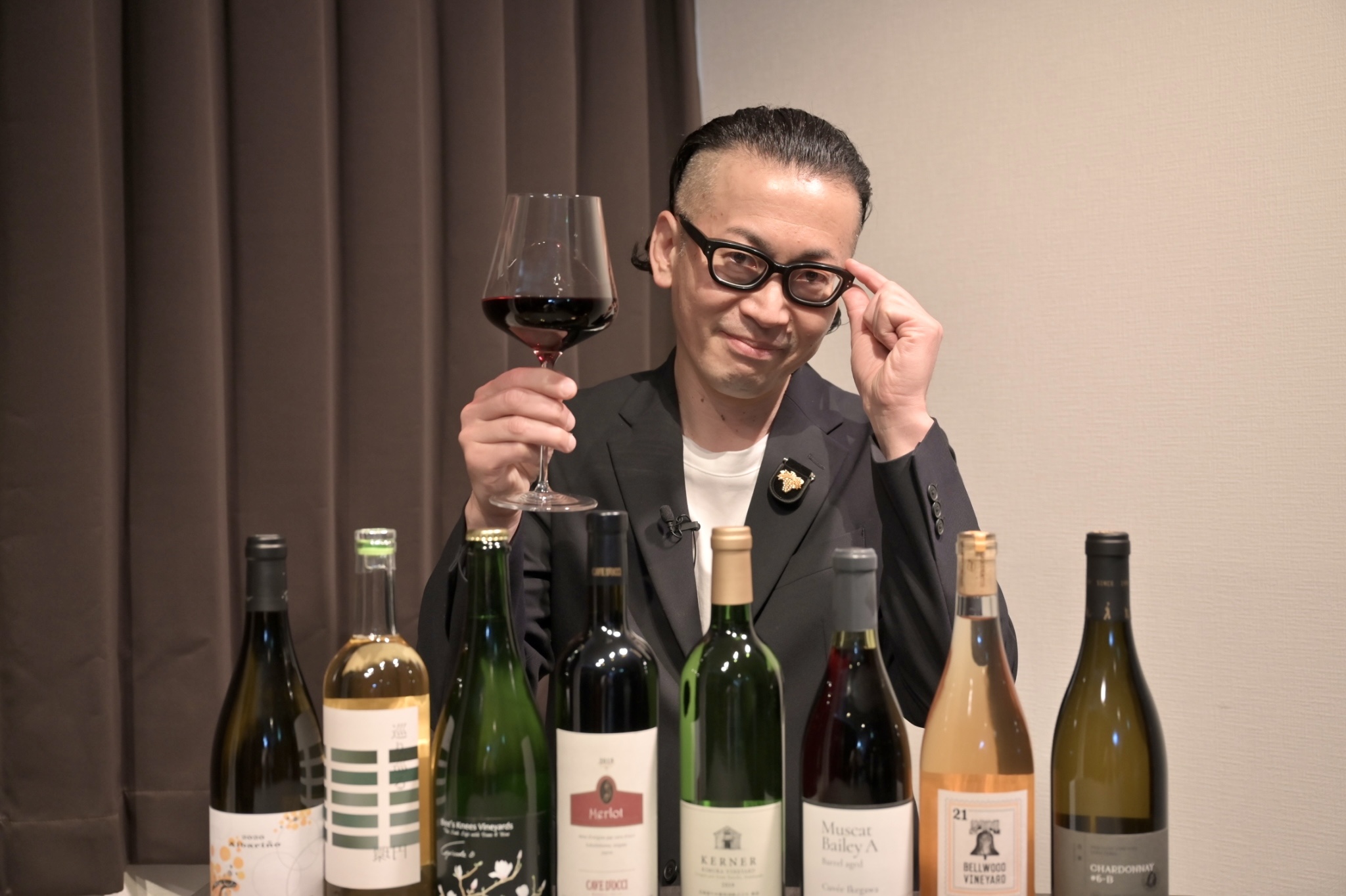
Finally
NIHON WINE.JP, a comprehensive web media outlet dedicated to Japanese wine, is read by a wide range of people—from beginners who have just recently developed an interest, to passionate enthusiasts who actively visit wineries around the country and 'Japanese Wine Masters' who have passed Level 1 of the Japanese Wine Exam. To wrap up, could you leave a message for the readers of NIHON WINE.JP?
"I'd love for people to post on social media whenever they taste a wine they find delicious, so that we can attract as many new drinkers as possible. That way, we can share information with each other.
Also, if you're interested in Japanese wine, I'd be delighted to welcome you to my online salon, 'Higuchi-kun's Japanese Wine Club' (laughs)."
Thank you very much for sharing so much with us today.
I'll put 'post on social media when you drink' into practice right away starting tonight!
Renaissance!!