
WINE TOURISM
"Natural Wine Is Living Wine": RAW WINE Founder Isabelle Legeron MW Speaks About Natural Wine

The global natural wine festival "RAW WINE" came to a highly successful close again this year. Traveling to cities around the world including Tokyo, London, Paris, New York, Montreal, and Shanghai, organic, biodynamic, and natural wi…
Contents
RAW WINE, the global festival of natural wine, closed another hugely successful edition this year.
Touring major cities around the world—including Tokyo, London, Paris, New York, Montreal, and Shanghai—it connects producers and enthusiasts of low-intervention wines, encompassing organic, biodynamic, and natural styles.
We spoke with founder Isabelle Legeron about RAW WINE and natural wine.
CHAPTER 01
About Isabelle Legeron
"Natural wine is a beverage filled with the memory of the land, the character of the winemaker, and the energy of live yeast. That’s why I want people to look at what’s inside the bottle, not just the label."
Originally from France and now based in London, she is a Master of Wine (MW) and a leading pioneer who has championed natural wine for many years.
Coming from a winemaking family in the Cognac region, her core inspiration lies in childhood memories of the scent of soil in her family's vineyards, harvesting by hand, and connecting with nature.
Her core philosophy rests on three consistent pillars: "Give consumers the right to know," "Give producers a place to share their story," and "Show respect to nature." RAW WINE is the physical manifestation of these ideals.

CHAPTER 02
What is RAW WINE?
"RAW WINE is a brand I launched in 2011," says Isabelle.
It was born out of frustration that there was no way of knowing "what is inside" or "how it was made"from looking at a wine bottle.
"Fifteen years ago, ingredients weren't even listed on labels. Even if it said 'Contains Sulfites,' consumers had no idea what that really meant."
That is why RAW WINE places "the pursuit of transparency" at its core.
This means disclosing everything—what farming methods were used to grow the grapes, whether sulfites or fining agents were used, and whether certifications are present.
CHAPTER 03
Energy and Internationality Felt in Tokyo
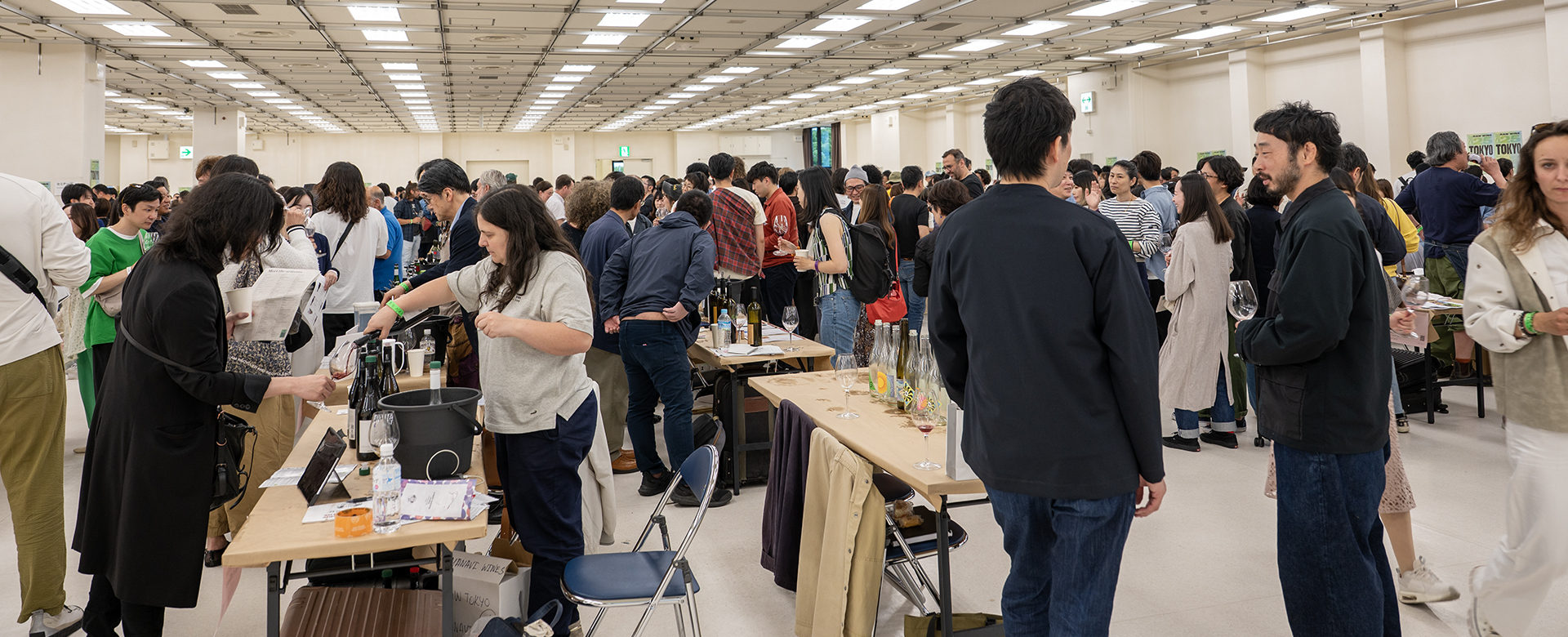
2025 marked the second edition of RAW WINE Tokyo.
When asked about her impressions, Ms. Isabelle shared that, following last year, this event was once again “filled with wonderful energy.”
“A wide variety of people gathered at the Tokyo venue, from general enthusiasts to natural wine professionals. There were also guests from Taiwan, South Korea, the Philippines, and Thailand, making it a truly international event.”
Being able to speak directly with the producers themselves is a major attraction of the event.
She considers it a valuable opportunity to hear about everything from their farming styles and philosophy to their meticulous winemaking practices.
CHAPTER 04
Wines That Leave a Lasting Impression Beyond Style
Quite a few people probably feel that natural wine has "unstable quality."
While delicious natural wines certainly exist, to be completely honest, I also recall encountering wines that were difficult to dismiss with plausible-sounding phrases like "flavor profile" or "typical natural wine character."
Although it was a sensitive question to ask, I took advantage of this opportunity to ask for her thoughts.
“That might be a misunderstanding born of preconceptions,”Isabelle replied.
“For example, the flavor profile image that ‘Sauvignon Blanc should be clear with citrus aromas…’ was created by modern winemaking technology. If fermented naturally, it becomes a wine that is more earthy, cloudy, and textured.”
To make an analogy, she explained that it is close to the difference between “soft, white industrial bread” and “wild yeast sourdough”—with sourdough possessing distinct character, deep flavor, and all the effort of the baker packed into it.
While natural wines may sometimes show volatile acidity or cloudiness, she contends that in many cases these are not defects, but rather “natural character.”
However, she adds:
“That said, a strong smell of acetic acid, ‘mousiness’ (an unpleasant aftertaste), or excessive Brett (Brettanomyces) are clear faults. In such cases, it is important to stabilize the wine with a small amount of SO₂ as needed.”
While this might seem obvious at first glance, it is nevertheless a crucial point.
Perhaps both producers and drinkers need to recognize once again that “natural character” and “faults” are two different things.
Ms. Isabelle went on to say, “I want people to taste with their bodies, not score with their heads.”
“Wine is a ‘food’ that has existed for 8,000 years. Yesterday, I drank miso soup at my hotel and was deeply moved by it. I didn't analyze its chemical components; it was simply delicious. It’s the exact same thing.”
CHAPTER 05
What she wants to convey to Japanese wine lovers
“The ultimate goal of RAW WINE is for every vineyard in the world to practice organic farming,”says Ms. Isabelle.
She believes that the Japanese sensibility toward nature and landscapes, as well as their aesthetic sense, has a deep affinity with natural wine.
“We live in an era where we enjoy wine as a luxury. That is precisely why I want people to choose and support sustainable, honest winemaking—and to discover the ‘living energy’ that natural wine possesses.”
 RELATED STORY大人気ナチュラルワインイベント!RAW WINE TOKYOが開催されました!
About the author