
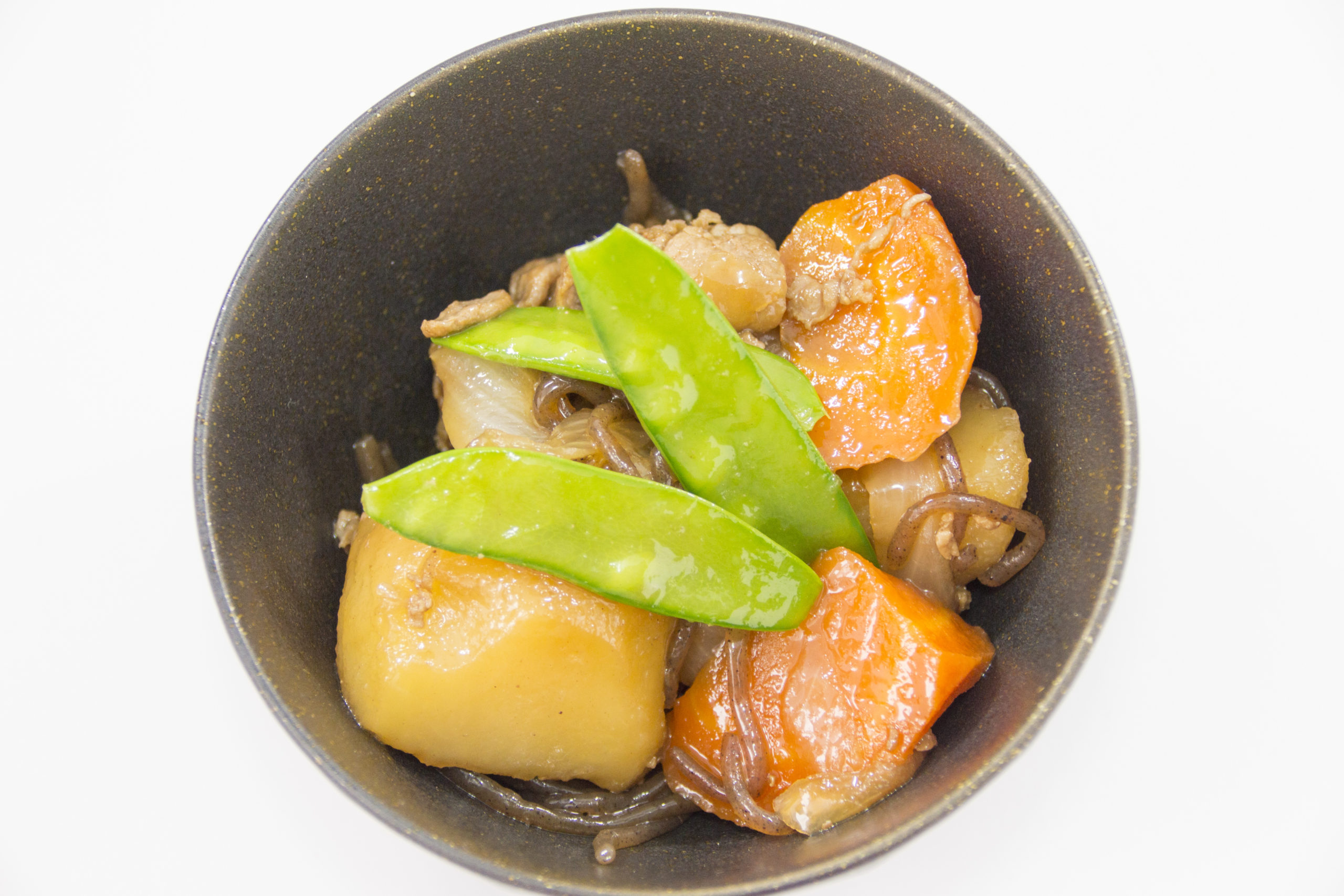
Nikujaga is one of the classic staples of Japanese home cooking.
While it is typically seen as a dish to be enjoyed with rice, many wine magazines and websites recommend pairing wine with nikujaga.
Personally, I also think it is not a bad pairing, but something suddenly dawned on me.
Namely, that what is often featured in these "wine x nikujaga" pairings is actually Kansai-style nikujaga...
If you are focusing specifically on compatibility with wine (including Japanese wine), choosing Kansai-style nikujaga over Kanto-style might just be the better option.
Here, I would like to explore the compatibility between Kansai-style nikujaga and Japanese wine.
Regional Differences in Nikujaga
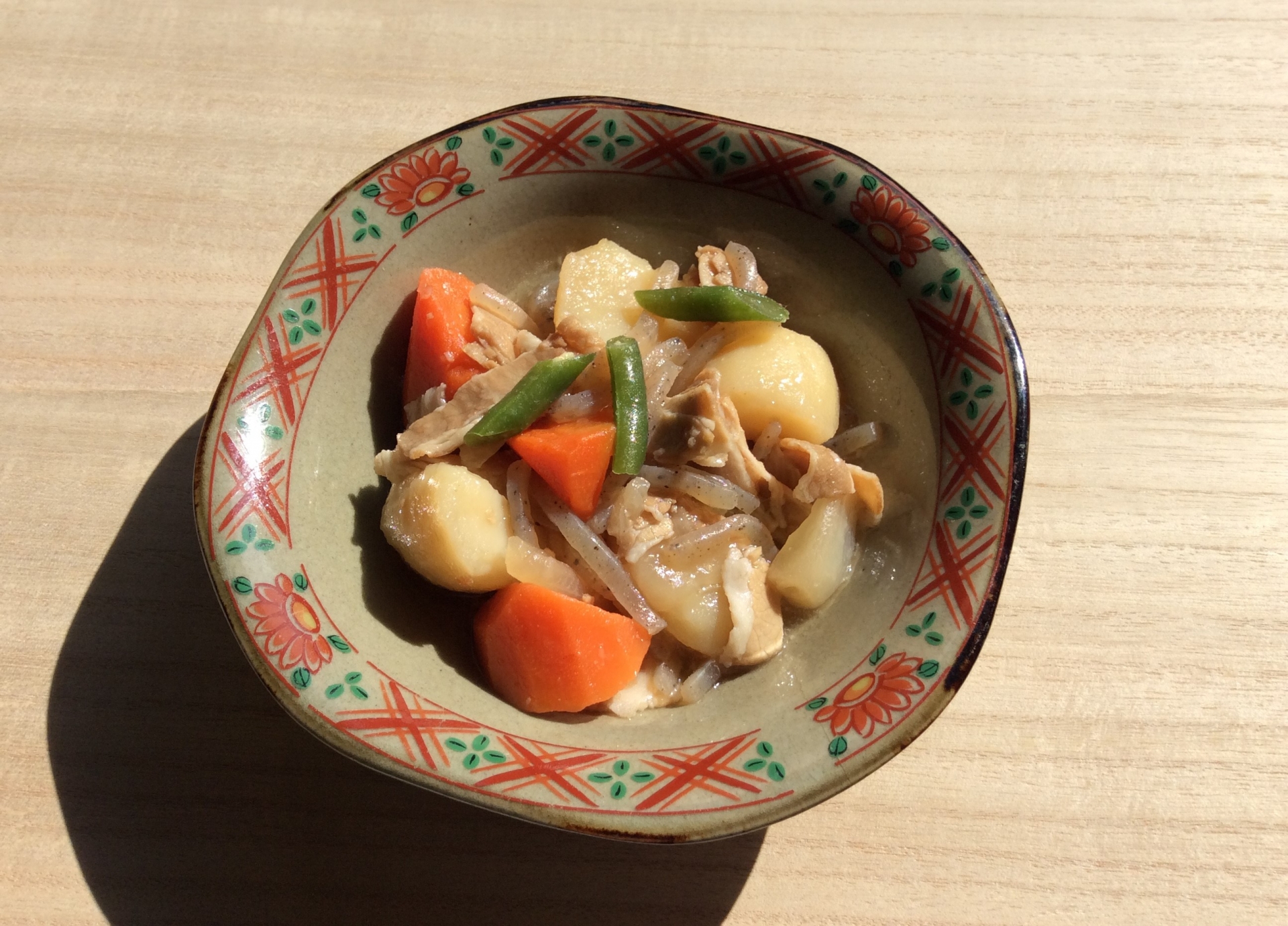
Nikujaga is a simmered dish made with meat, potatoes, carrots, onions, snow peas or green beans, and shirataki noodles (depending on the household).
There is probably no Japanese person who has never eaten it before. (Personal preferences aside...)
Now, regarding such nikujaga.
It seems that the choice of meat and seasonings differs depending on the region.
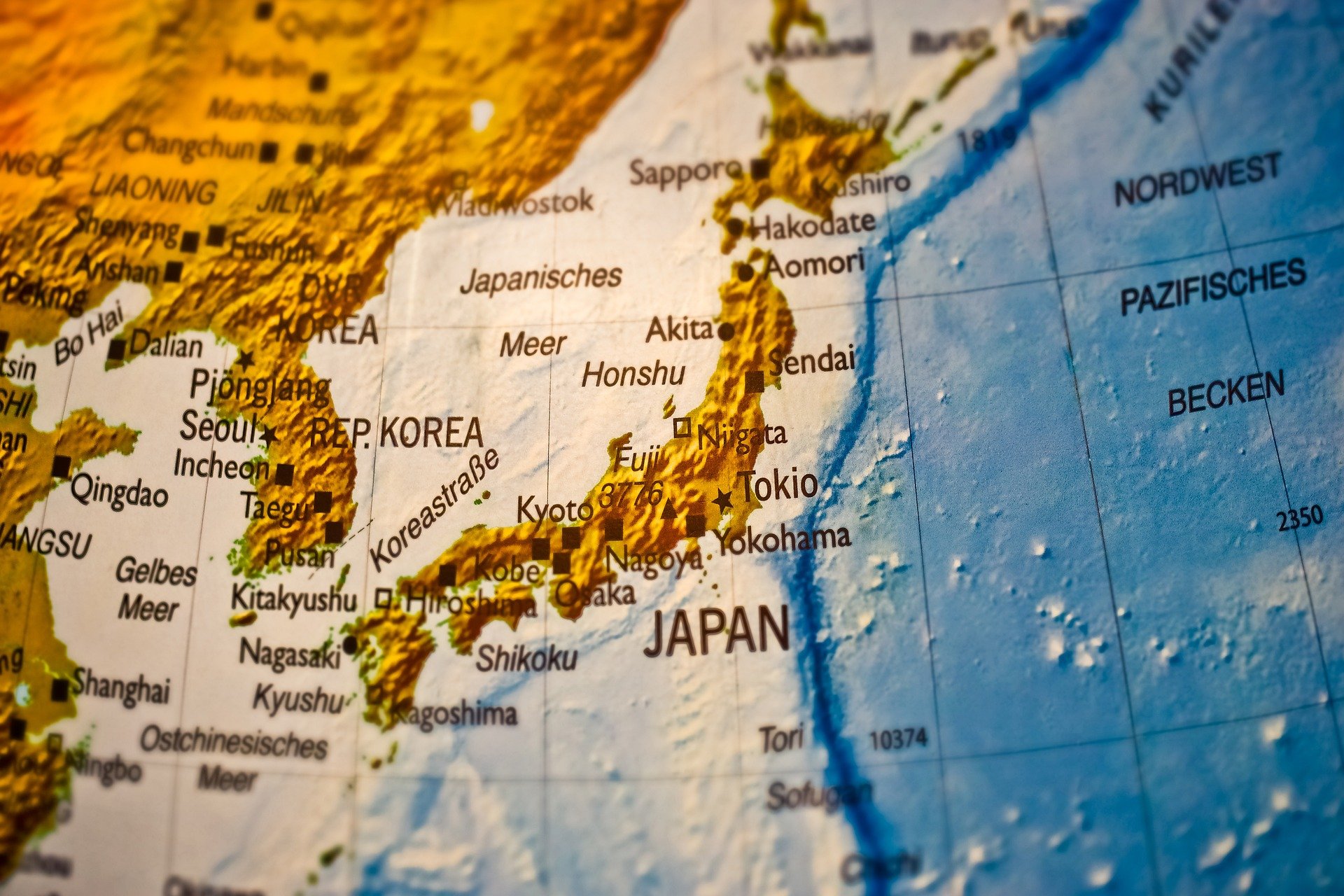
According to a nationwide survey conducted by J-Town Net asking "Do you use pork or beef in nikujaga?", the pork camp dominates from the Kanto region (including parts of Chubu) through Tohoku and Hokkaido, while the beef camp is dominant from Kansai all the way to Kyushu...
As someone from Yamanashi Prefecture, where it is 100% pork, I was initially surprised to learn that there are places where "the meat used in nikujaga is beef."
While there are various theories, it is said that this difference stems from historical practices where horses were used for farming in Kanto, while cattle were used in Kansai. (Another factor is said to be the pig farming boom that occurred in the Kanto region after the Great Kanto Earthquake...)
However, since Kanto and Tohoku are not 100% pork-only and also have beef advocates, one cannot sweepingly generalize that Kanto is strictly pork.
For the purposes of this discussion, we will proceed under the broad classification that Kansai-style nikujaga means "using beef."
Differences in Seasoning
Now we know that beef is the main star in Kansai-style nikujaga.
So, are there differences in seasonings as well?
First, Kansai-style is often seasoned to bring out the umami of beef, and it seems that Japanese dashi broth and sugar are frequently used in generous amounts.
In the past, Calbee released a limited-edition "Jagarico Nikujaga Flavor" under the concept of enjoying regional flavors; when looking into it, the seasoning was Kansai-inspired, emphasizing the umami of beef and sweetness.
Kanto-style, rather than focusing on the umami of pork, has the image of a slightly sharper (saltier?) flavor profile that well-balances soy sauce, mirin, sugar, and dashi. (That was certainly the case in my family's home.)
Some recipes even call for beef tallow to make Kansai-style nikujaga even more delicious, and while Kanto-style uses water, Kansai-style often uses sake; thus, there seem to be differences in how the ingredients' flavors are extracted and in the levels of sweetness.
If Pairing with Wine, Choose Kansai-Style Nikujaga

Considering these differences, if you are going to try "nikujaga x wine," the Kansai style seems to be the better choice.
In the case of red wine, from the viewpoint of wine tannins washing away the fat of beef, Kansai-style nikujaga—which uses beef and enhances its umami with beef tallow—clearly takes the prize.
In the case of white wine as well, since Japanese wine offers fruit-derived sweetness and umami, the Kansai-style nikujaga with its pronounced dashi flavor and sweetness seems to pair wonderfully. (Though a crisp Koshu might go nicely with Kanto-style...)
In addition, the aroma components of bonito dashi are said to include pyrazines, phenols, and sulfur-containing compounds, and since some wines contain similar aromatic components, it can be considered that they will not clash in terms of aroma either.
Incidentally, there are many recipes for "Western-style nikujaga" that incorporate red wine, but the meat ingredient is inevitably beef.
Calling it "a Kansai-style nikujaga made Western-style" makes it somewhat confusing to identify what cuisine it belongs to anymore, but at any rate, when pairing with wine, there is no doubt that Kansai-style nikujaga using beef has greater affinity.
Wine from Kansai Should Pair Perfectly with Kansai-Style Nikujaga!
One of the fundamentals of wine and food pairing is matching the region of origin.
Since matching micro-regions strictly can be tricky, I tried a "Kansai pairing" within a broader framework.
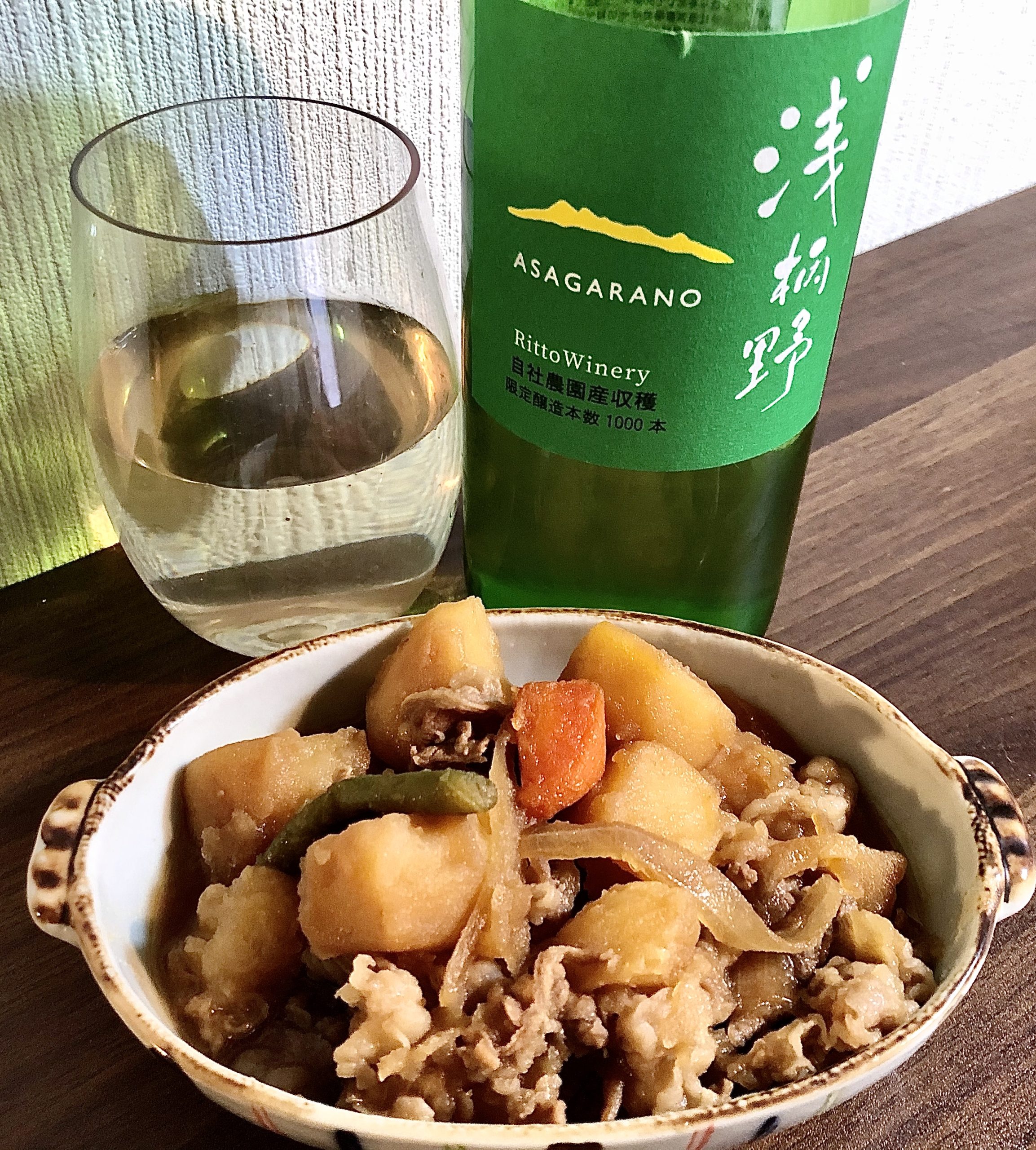
This time, what I paired with the Kansai-style nikujaga was "Nouveau Sunny Rouge" from Ritto Winery (Lake Biwa Winery) in Shiga Prefecture.
This is a white wine made from estate-grown Sunny Rouge, and is a nouveau from the 2020 vintage.
It presents aromas suggesting sweetness alongside white floral notes, with a mellow palate that delivers dashi-like nuances and grape-driven fruitiness.
At the same time, the acidity remains intact, keeping it from being overly sweet and imparting a taut impression.
It shares great affinity with the dashi flavor of Kansai-style nikujaga and strikes just the right balance in sweetness.
Furthermore, it firmly embraces the umami of the beef, while refreshing the palate in the aftertaste.
Since it is a white wine with nuances somewhat reminiscent of sake (ginjo aroma), it proved to be a flawless match for Kansai-style nikujaga.
Kanto vs. Kansai Differences Might Exist in Wine as Well!?

Even for the same dish, nikujaga, the ingredients used differ between Kanto and Kansai.
Isn't that a truly fascinating topic?
Today, Japanese wine is produced not only in Kanto and regions further north, but also abundantly from the Kansai region down to Kyushu.
Perhaps certain differences emerge somewhere, even with the same grape varieties and winemaking methods.
Just like with nikujaga, if the distinct regional character of Japanese wine becomes clearly evident, choosing wine will become all the more enjoyable.
Although it will be a personal project, I plan to research these differences in Japanese wine going forward.
Reference