

There is a football club taking on a challenge that has yet to be achieved even in Yamanashi or Nagano.
It is FC Imabari, operated by Imabari. Yume Sports Co., Ltd. in Imabari, Ehime, under former Japan national-team manager Takeshi Okada.
A new home stadium is currently being built in Imabari, and this year grapevines were planted on the slope of the stadium site, which sits on elevated ground.
A vineyard attached to a football stadium is highly unusual even by global standards.
We spoke with Kotaro Kurokawa of FC Imabari (Imabari. Yume Sports Co., Ltd.)'s Corporate Planning Office.
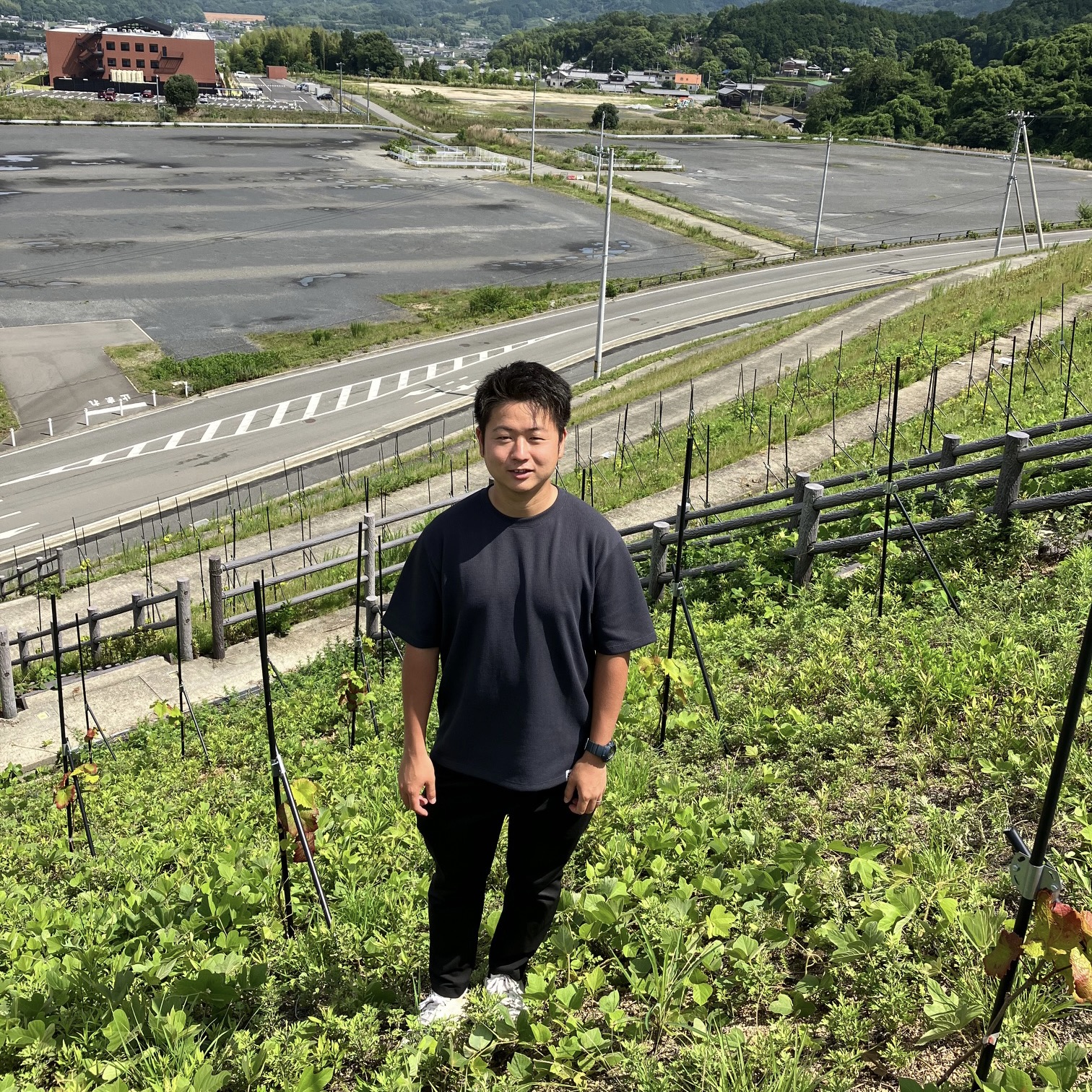
Interview with Mr. Kurokawa
—Please tell us about the vineyard project.
We have planted 128 Yama Sauvignon vines and another 128 Muscat Bailey A vines.
In addition, there are 15 vines that were planted experimentally one year earlier.
By planting them in different locations, we are observing differences such as drainage.
We chose Muscat Bailey A because Omishima Minna no Winery already has experience growing it. Yama Sauvignon was also selected because, similarly, it is relatively resistant to disease.
—How has the first year of trial planting gone?
I realized mowing the grass is quite a lot of work. (laughs)
—Are you doing all of this by yourself?
When we planted the vines, club staff were joined by members of a volunteer organization called “Voyage,” which normally helps with the operation of home matches.
About 30 people planted the vines together.
We had actually planned an event for around 100 people, but the forecast called for rain, so we canceled it and planted the vines the day before, on January 22, 2022.
For ongoing maintenance, people mow whenever they notice it needs doing, but if I don't get involved myself, the weeds tend to win.
Report from the planting day
(from the “FC Imabari Satoyama Stadium Project” page)
https://satoyamastadium.com/1126/
—We understand you previously worked at the Ministry of Agriculture, Forestry and Fisheries. Did you already have a personal interest in things like grape growing?
I studied law at university, so to be honest I don't know that much about cultivation. (laughs)
I joined the Ministry of Agriculture, Forestry and Fisheries because I had a strong interest in production sites and a strong belief that those places are what support our food system.
I like being out in the field.
—Has this vineyard essentially become your responsibility?
I suppose that's more or less how it has turned out. (laughs)
—Why did you decide to plant grapes here, on the stadium slope, in the first place?
When we leased the land from the City of Imabari, this slope was included.
When the question came up of what to do with such a large slope, Okada suddenly said, “I'm going to grow grapes here and make wine!”
—So it was Chairman Okada's idea.
That's right.
Okada said, “I'm serious about this, but nobody is taking me seriously,” so I said, “…Then shall we buy some vines?” and started moving things forward in concrete terms.
—FC Imabari is involved in a range of businesses, but this vineyard is not yet a business in its own right.
That's correct. Of course, it isn't generating any revenue at this stage.
It takes at least three years before wine grapes can be harvested, so for now this is a test—an experiment.
If things go well, in three years we should be able to make about 1,000 bottles of wine through contract winemaking, but nothing has been decided yet, including how we would sell it.
We plan to think about the future while watching the results of this grape-growing project.
—What are the characteristics of the soil here?
The basic soil is masa, or decomposed granite soil, which is typical of western Japan.
Because this is a slope, drainage is naturally good. On flat land, infiltration is slower and drainage poorer, but this vineyard is different.
To be honest, we can't devote an enormous amount of labor to it, so for now we are thinking of a natural-farming-style approach without particular disease-control treatments.
Looking at the trial plantings, I have the impression that varieties such as Concord may suit this site.
—How do you plan to train the vines?
Rather than using a conventional trellis or pergola system, I once saw vineyards on the steep slopes along Germany's Rhine River and would like to use those as a reference.
I am thinking of letting the vine grow upward, taking two long canes from left and right, and tying them in a heart shape around a stake placed alongside the trunk—a kind of stake-training system.
—We understand you receive advice from Mr. Kawada, who handles cultivation and winemaking at Omishima Minna no Winery.
Yes. He teaches us what to do at each stage, such as planting and shoot thinning.
I expect pruning will be the next task he teaches us.
—Mr. Kawada often talks about wanting to establish a wine culture in the Shimanami area.
This place may eventually become part of that movement. Perhaps one day we will hear the announcement, “We've built a winery!”
Yes. I would be very happy if we could take it that far.
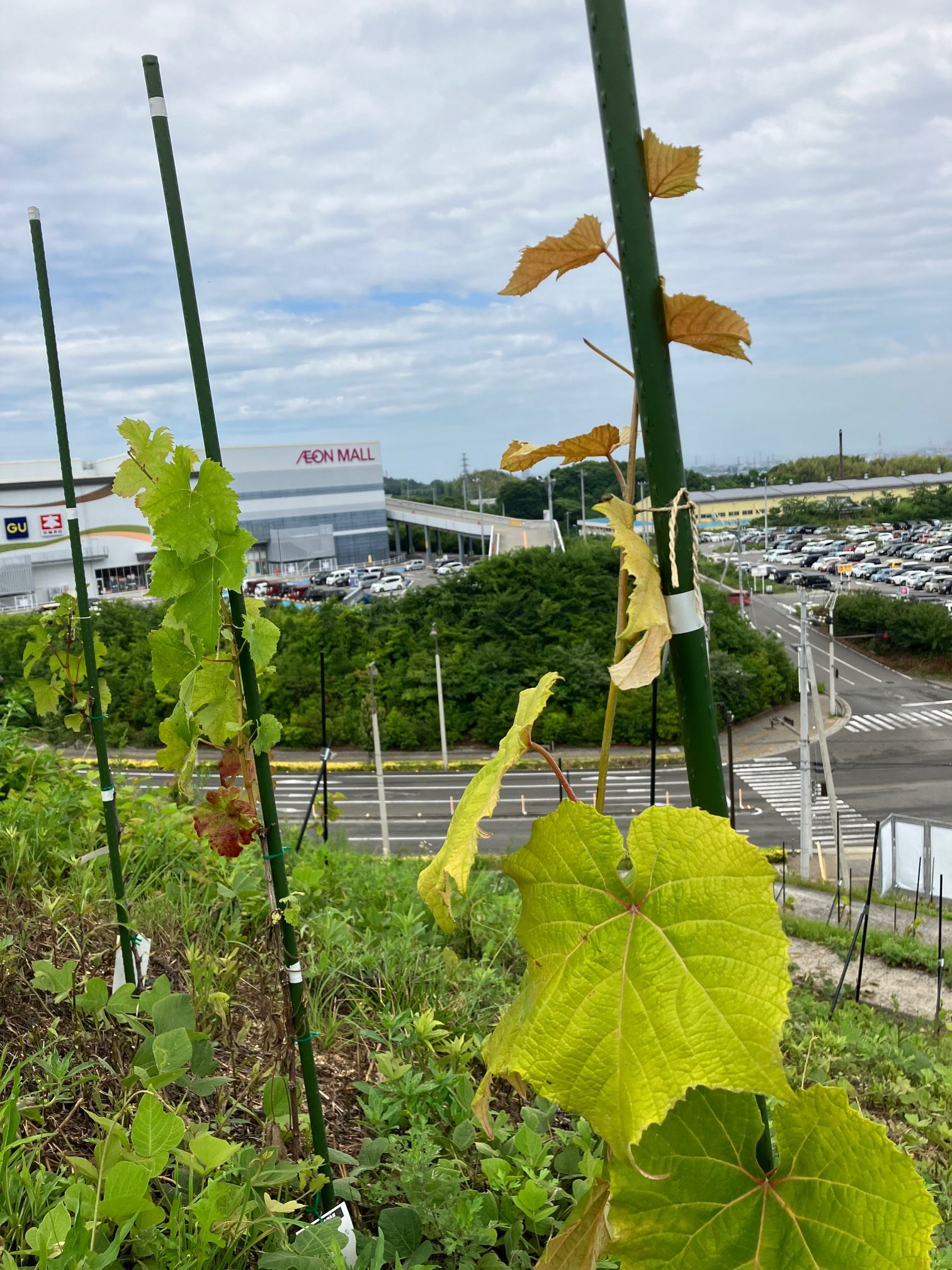
A stadium winery that is rare even by global standards—we can't wait to see what kind of wine it produces.
Thank you very much.