

Among the many wines out there,"I can't resist sparkling wine"many people would say.
The refreshing flavor and complexity that suggests depth, the popping texture of carbonation.
Taste aside,"glamorous presence"some may be captivated by that alone.
Now, when it comes to the characteristics of sparkling wine, it's"bubbles", but apparently these bubbles hide a flavor distinct from the wine itself.
That flavor hidden in the bubbles is...
Here, we'll delve into the relationship between sparkling wine and bubbles in two parts.
First,Part 1 will explain "bubble persistence".
Bubble Persistence
There are various types of sparkling wine.
Among them, especially those"with persistent bubbles"are considered high quality, and in particular, "Champagne" is said to possess all the essential qualities when discussing "premium sparkling wine."
Why is Champagne high quality...?
There are various reasons, but one of the secrets ispressure.
Sparkling wine production methods are broadly divided into...
- Traditional method (secondary fermentation in bottle)
- Charmat method (secondary fermentation in tank)
- Carbonation method (carbon dioxide injection)
these three types (there are more if you break them down further), and Champagne is produced by secondary fermentation in bottle.
Incidentally, since sparkling wines made by secondary fermentation in bottle exist in various countries, including Spain's CAVA and France's Crémant,we can't categorically say "Champagne is supreme," but... here we'll explain using Champagne.
Now, let's look at how this production method relates to pressure.
Focus on the Pressure of Secondary Fermentation in Bottle
While we'll cover the details of secondary fermentation in bottle on another occasion,let's review the basic process.
Primary fermentation (still wine production)
↓
Assemblage (blending past vintages, different plots, different varieties, etc. to match the target wine quality)
↓
Secondary fermentation (wine, sugar, and yeast are placed in the bottle for a second fermentation)
↓
Aging
↓
Commercialization
Of course, there are more complex steps involved, but roughly speaking, it's like this.
Generally, those made by secondary fermentation in bottle have the highest pressure, followed by tank secondary fermentation, then carbonation in descending order. (Because long-term aging in a narrow bottle increases pressure)
Gas pressure of sparkling wines made by secondary fermentation in bottle, such as Champagne
(5-6 atmospheres at 20°C)
Gas pressure of sparkling wines made by tank secondary fermentation
(3-4 atmospheres)
Gas pressure of sparkling wines made by carbonation
(2.5-3.8 atmospheres)
Now, let's explain why higher pressure results in better bubble retention.
Solubility Was the Key
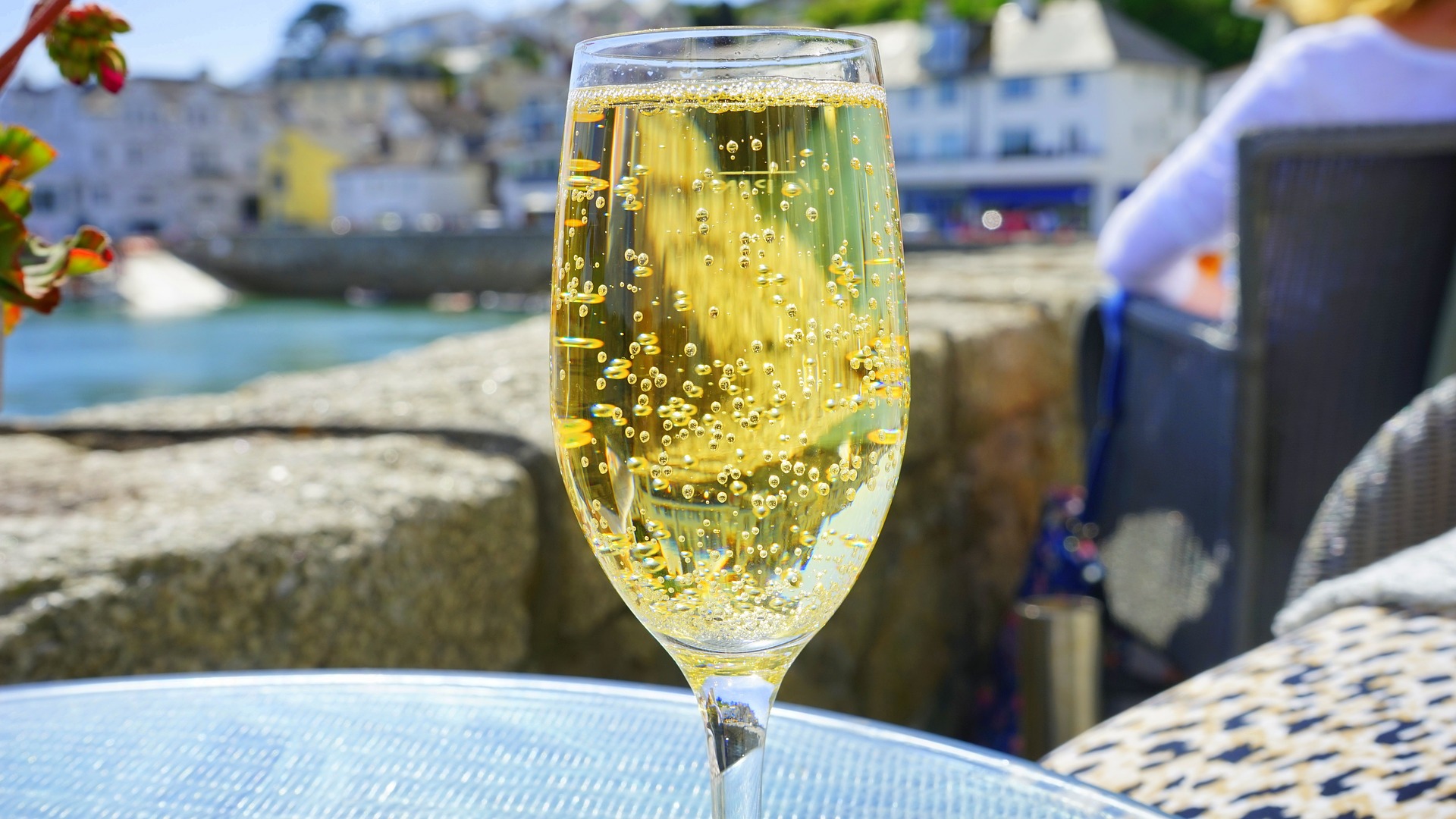
Gases such as carbon dioxide have the property of"becoming more soluble as pressure increases"(Henry's law).
For example, when we purchase Champagne, we cannot see bubbles in the liquid while it's unopened on the store shelf.
As mentioned earlier, in the case of Champagne with a pressure of 5 or more atmospheres,all the carbon dioxide produced during secondary fermentation in bottle is dissolved, so no effervescence can be observed... that's what it means.
Then when uncorked, atmospheric pressure becomes about 1 atmosphere, causing the solubility of carbon dioxide to decrease sharply.
About 80% of the dissolved carbon dioxide is mostly released into the air, sothe remaining approximately 20% of carbon dioxide rises through the wine as "wine bubbles"...that's how it works.
In other words, in the case of Champagne, which has high pressure and therefore a large amount of carbon dioxide dissolved in the liquid, the remaining 20% of carbon dioxide is substantial.
Sparkling wines with lower pressure and fewer bubbles have lower carbon dioxide solubility, so if not consumed quickly, they rapidly become flat and tasteless,"carbonation-free wine"... that's what happens.
Here we can consider one reason why Champagne is a premium sparkling wine.
First, Understand Bubble Persistence
The life of sparkling wine is, without exaggeration,"bubbles".
Just knowing about bubble persistence will change how you choose sparkling wine.
Now, Part 2 will consider the flavor of bubbles.
Once you understand this,you should comprehend why bubble persistence is what determines the quality of sparkling wine.
Good to Know! What is the Deep Relationship Between Sparkling Wine and "Bubbles"!? Click Here
Reference
Why Does Crispy Bacon Smell So Good? Written by Andy Brunning | Translated by Hideyo Takahashi | Translated by Hideaki Natsukari