

When hearing about components contained in wine, many people may think of polyphenols.
Polyphenols are components associated with bitterness and pigments, and they are particularly famous for contributing to the astringency of red wine.
Recently, a research group led by Professor Naomi Osakabe (Laboratory of Food and Nutritional Sciences) of the College of Systems Engineering and Science at Shibaura Institute of Technology revealed that the astringency of "flavanols (flavan-3-ols)," a type of polyphenol also contained in wine, immediately activates neural systems involved in memory and arousal, and further elucidated the mechanism of their action on the brain.
Therefore, this time, we interviewed Professor Naomi Osakabe (hereafter Professor Osakabe) about the details of this research, as well as the effects polyphenols have on our bodies.
Please take a look and use it as a reference.
The Effects of Flavanols on the Brain

Flavanols are a type of flavonoid compound among polyphenols; they are representative polyphenol compounds that possess astringency and are also found in wine.
Professor Osakabe: "Flavanols had long been thought to have some form of activity. Among reliable evidence, the large-scale intervention trial on astringent flavanols published in 2022 by a public health laboratory at Harvard University is well-known. In this study targeting about 20,000 people who ingested flavanol capsules for 3 years and 6 months, it was suggested that cardiovascular disease mortality was suppressed by 40%."
In addition, a cognitive function test targeting 4,000 people published in 2023 is also known as reliable evidence regarding the effects of flavanols on the brain.
Professor Osakabe: "A distinctive feature of this study is that it was conducted across three groups: health-conscious people, average people, and people who are not health-conscious. When these individuals were given flavanols, it was found that the hippocampal-dependent cognitive function of people who are not health-conscious improved. The inability to undergo neurogenesis in the hippocampus is linked to dementia. This study yielded results suggesting that flavanol intervention might help prevent dementia."
It is also known, as established by the European Food Safety Authority (EFSA) of the EU in 2013, that consuming flavanols increases blood flow.
Polyphenols are said to be good for health, and the fact that flavanols offer such promising effects should be reassuring news for wine lovers.
The Mystery of How Polyphenols Work
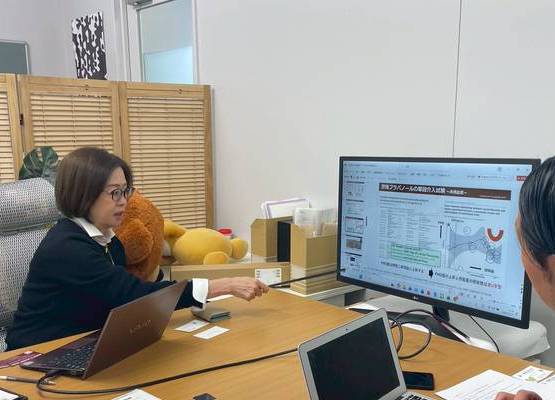
It is known that polyphenols, such as flavanols, bring about some beneficial effects to our bodies.
However, according to Professor Osakabe, the mechanism behind this had not been elucidated for many years.
Professor Osakabe: "Although more than 8,000 types of polyphenols exist, they are actually not absorbed by our bodies. The reason is that because polyphenols are compounds where multiple hydroxyl groups are bound, they generate reactive oxygen species. Since reactive oxygen species cause harmful effects, the body perceives them as dangerous and does not take them in. Yet, polyphenols have beneficial effects on our bodies. This mechanism remained unsolved for a long time."
Throughout our long history, humans made the choice not to absorb polyphenols into the body, leading some theories to suggest that they might be doing something while on their way to being excreted.
Professor Osakabe: "There was also the line of thinking that if polyphenols are not absorbed into the body, gut microbiota might be involved. However, gut microbiota differs completely from person to person, and lactic acid bacteria taken from outside have the characteristic of not colonizing. If gut microbiota were responsible, one cannot help but question how that could explain an outcome where as much as 40% of people saw a reduction in cardiovascular disease mortality, as in the large-scale intervention trial of astringent flavanols mentioned earlier."
Focusing on Taste
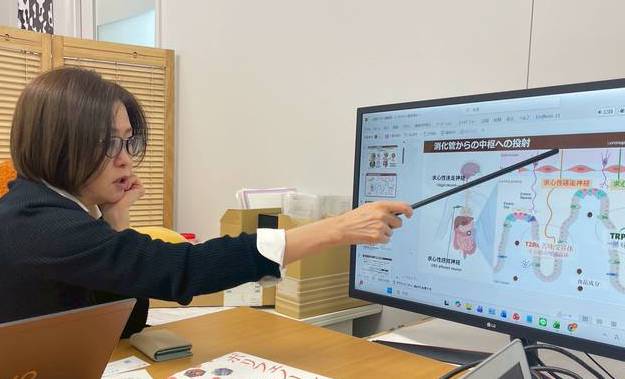
Why do polyphenols bring about beneficial effects despite not being absorbed into the body?
What Professor Osakabe focused on was taste.
Professor Osakabe: "As mentioned, flavanols with strong astringency increase blood flow, and that action is striking when observed in animals. Comparing mice administered water and mice administered flavanols revealed that blood flow increased in the latter. Furthermore, the result appeared after just 5 minutes, which made me feel that 'this can only be related to nerves.'"
Polyphenols themselves number more than 8,000 types, and each reportedly has different tastes such as bitter, astringent, sour, or sweet.
Receptors that detect these various tastes exist not only in the oral cavity but also in the digestive tract, and because pathways transmitting signals to the brain were already known to exist, she hypothesized that the effects brought about by polyphenols might stem from "taste" rather than internal absorption.
Furthermore, when trained panelists tasted polyphenols, they discovered substances that evoke sourness and sweetness in addition to the conventionally known astringency and bitterness, and finding that substances exhibiting astringency and bitterness in particular had effective physiological actions led to the prediction that taste might be involved.
Professor Osakabe: "Astringent or bitter components might be doing something. We created model formulas to calculate whether each of the vast array of polyphenols binds easily to bitter taste receptors and derived results, but up to that point, it was purely theoretical. Later, in animal experiments, bitter polyphenols showed effects such as lowering blood glucose, but when bitter taste receptors were knocked out, that effect vanished. Through this result, we proved the affinity between polyphenols and bitter taste receptors that we had calculated."
Confirming the Effect of Flavanol Astringency
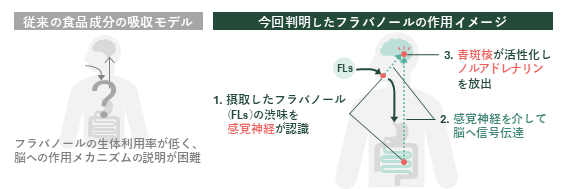
Professor Osakabe focused on the possibility that the sensory stimulation of "astringency" from flavanols, a type of polyphenol, sends signals to the brain via oral and intestinal nerves.
Professor Osakabe: "Incidentally, the fact that polyphenols improve blood flow suggests that the sympathetic nervous system is activated. The sympathetic nervous system is related to stress, but moderate stress from things like saunas or moderate exercise is good stress. It also boosts memory and heightens attention, which connects to the improvement of hippocampal cognitive function seen in the earlier study. If some change is occurring in the brain due to astringency, I wanted to verify it. So, we conducted an experiment administering flavanols to mice."
In mice administered flavanols, neurotransmitters such as noradrenaline and dopamine increased, whereas nothing happened in mice administered water, confirming that the astringency of flavanols has some sort of effect.
Professor Osakabe: "This time, the key was that the locus coeruleus in the brain was activated immediately. The locus coeruleus is also involved in regulating memory and other functions, so we focused on how the mice would behave—in other words, on cognitive function."
Comparing mice administered flavanols with mice administered only water, the former showed strong interest in novel objects and explored them, confirming that short-term memory had improved.
Furthermore, after multiple administrations of flavanols, neurons in the hippocampal dentate gyrus were found to have increased, suggesting that this may also be linked to the enhancement of hippocampal-dependent cognitive function observed in previous research.
In addition, transformations into brown adipose tissue, which is said to make white adipose tissue less likely to accumulate, and muscle hypertrophy were observed, confirming that flavanol astringency enhances memory and arousal states and activates stress responses via oral and intestinal nerves.
Enjoying Wine While Paying Attention to Flavanol Functions
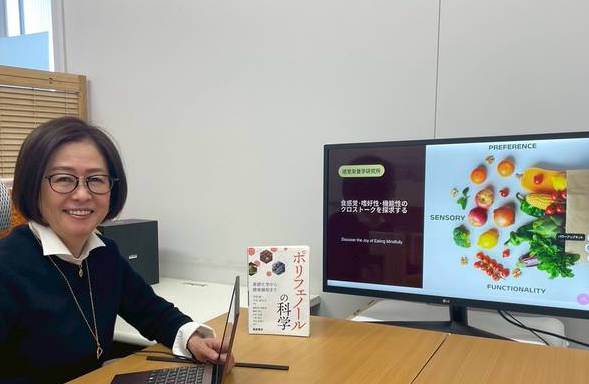
Professor Naomi Osakabe, whom we interviewed this time, led the development of Meiji Co., Ltd.'s "Chocolate Kouka Cacao 72%" and is an extremely renowned professor in polyphenol research.
She is also a pioneer in "sensory nutrition," a new academic field that uncovers the mechanisms through which sensory stimuli like "astringency" exert effects on various regions of the brain.
This time, we were able to learn about research fascinating to wine lovers as well, including the demonstration that the astringency of flavanols immediately activates brain networks involved in memory and arousal via nerves as sensory stimuli, and the possibility that "taste" and "sensation" can influence the brain and autonomic nervous system.
"Wine is an alcoholic beverage, and I think of it not as something to drink alone, but as a drink to enjoy together with everyone alongside delicious food. It has cultural aspects, contains polyphenols, and is good for the body. I believe it is an important presence that humans have cultivated across eras. I love red wine myself, so please enjoy it while also being mindful of wine's polyphenols," said Professor Osakabe.
She also hopes to expand the field of "sensory nutrition" in the future, so why not keep an eye on Professor Osakabe's research if you are a wine fan?
* From Tuesday, October 13 to Saturday, October 17, 2026, "ICPH & ICoFF2026" (The 12th International Conference on Polyphenols and Health / The 9th International Conference on Food Factors) will be held at Pacifico Yokohama North.
It is a large-scale event in which Professor Osakabe is also involved, so if you are interested, please check the URL.
https://smartconf.jp/content/icph-icoff2026/
Reference
■ Paper Information
Paper Title: Astringent flavanol fires the locus-noradrenergic system, regulating neurobehavior and autonomic nerves
Authors (Excerpts of University Affiliates): Yasuyuki Fujii (Specially Appointed Researcher, SIT Research Laboratories, Shibaura Institute of Technology), Keisuke Shinoda (Doctoral Program, Major in Functional Control Systems, Graduate School of Shibaura Institute of Technology, completed in 2025), Yuki Yamato (Master's Program, Major in Systems Engineering and Science, Graduate School of Shibaura Institute of Technology, completed in 2025), Kazuo Sakata (same, completed in 2025), Orie Muta (same, completed in 2025), Yuta Nagata (Doctoral Program, Major in Functional Control Systems, Graduate School of Shibaura Institute of Technology, completed in 2025), Asuke Ono (Doctoral Program, Major in Functional Control Systems, Graduate School of Shibaura Institute of Technology, completed in 2025), Mizuki Azumi (1st Year, Major in Systems Engineering and Science, Graduate School of Shibaura Institute of Technology), Naomi Osakabe (Professor, College of Systems Engineering and Science, Shibaura Institute of Technology)
Journal: Current Research in Food Science (Volume 11, 2025, 101195)